<I>
I guess the first thing you’ll want to know is where I was born. I’m not really up for all that autobiography crap – my childhood, the time I put that bastard Pedro Mendes in hospital. That stuff goddam bores me, but I’ll answer that first question. Swindon – home of XTC, WHSmith and that kid from The Curious Incident of the Dog in the Night-Time. It was pretty depressing, but no-one gets to choose where they start out.
No, I wasn’t born in Wales but Mark Hughes knew that when he called me up to the squad. My grandma was Welsh. Hughesy knew that, and I guess he knew that after playing for the Under-21s, England just didn’t want to know about me. We didn’t talk about that, though. They had Psycho, then Graeme Le Saux, then Wayne Bridge and Ashley Cole, hell even inbetween they preferred Pip Neville’s right foot at left back. I knew when I wasn’t wanted.
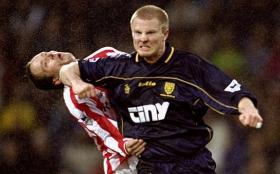
It was Vinnie Jones who first suggested it, back when I was at Wimbledon. I’d just arrived from Millwall and Euro 96 was making everyone a little football crazy. To tell you the truth, I was pretty sore to have missed out. I should have been out to impress at my new club but pre-season was boring as hell. Sure I was young, not yet 21, but I was highly thought of in FA circles. I was the classic old school British defender, all take the man and find row Z. The smug old blazers left me cold but everyone said I was taking the right route, shaking the right hands – Lilleshall like Sol Campbell and Nicky Barmby, then the Under-21s with Richard Rufus and Kevin Gallen. Very big deal. It seemed like it was only a matter of time before I joined the seniors.
‘What happens if Psycho gets injured? Are you telling me Steve Howey is going to do the business on the left?’
We were doing a passing drill and I was shooting the bull, acting the cock of the walk. Vinnie liked it that way, so that he could take you down a peg or two. The guy was intent on keeping that damn Crazy Gang spirit alive, even if Fash was long gone.
‘You think you’re next in line to the throne, boy? Forget it, you ain’t all that. You’ve got no chance in hell playing here and that England team’s cursed anyway. If I was you, I’d start looking into your family history. You think I give a fuck about Wales? I was born in bloody Watford!’
JFK kicked a ball in my face. He was hot as a firecracker, always yelling. The gaffer was in cahoots with Vinnie, but I was fair game. ‘Oi Thatcher, wakey wakey! You think you’re still on fucking holiday? Kimble is 30 going on 80 and his right foot has seen even less action than your dick, but I’ll still pick him over you!’
I wasn’t too crazy about Old Kinnear, to tell you the truth, but that wasn’t unusual with me and my managers. I’ve hated pretty much every one of them – they never act like people. Sometimes I worked really hard on my game but they never notice anything.
<II>
So Vinnie got me thinking back then but it wasn’t until seven years later that I did anything about it. Inbetween, things hadn’t exactly gone to plan. There were no big trophies, and most importantly no England caps. I had a reputation as a hardman, a ‘dirty’ player with a habit of swinging elbows. I can’t say I was misunderstood exactly but that wasn’t all I was about. Then in 2000, Wimbledon got relegated. It was sad to see but things really soured once JFK left. The old brute had health issues, and they replaced him with this weird Norwegian with tiny little eyes. He tried to introduce football science to the Crazy Gang and boy did he learn his lesson. It was like trying to teach a fish to walk.
I went to Tottenham for £5million and at first everything was pretty great. There were some big players around the place and I got a bang out of that. Tim Sherwood had a Premier League winner’s medal and he would play all manner of pranks. One day he called Stephen Carr’s wife, pretending to be her husband’s rent boy. That killed me. George Graham was a nice guy but he wasn’t the cleanest and he ended up paying the price for that.
Hoddle arrived and boy did he think the sun shone out of his arse. He was a real phony and one of the biggest bores I ever met. He made his mind up early on and he chose Taricco and Ziege over me. I got the axe and I was really hot about that. I was playing well when I got the chance but it made no difference. I had plenty of dough but it didn’t feel right taking it for just sitting my ass on a bench each week. Goddam money; it ends up making you blue.
I kept thinking about my days at Lilleshall when it felt like I was going places. What a deal that was. I started getting sorry for not working a little harder, for not keeping my cool a little more. One thing I have, it’s a terrific temper. I was damn near ready to just quit and become a physiotherapist or something.
‘That Hoddle’s a real bastard. Some day somebody’s gonna bash his-’
Stephen Clemence didn’t even bother to listen; he wasn’t on the gaffer’s naughty list yet. We were in the club car park and he just shut the damn door and drove off.
I needed to get out of White Hart Lane. I thought of giving JFK a buzz but I wasn’t sure he even had a phone. Maybe the poor old guy was dead; I never read the news. Instead I walked the streets of London, just for the hell of it. It was a cold February evening and I wished I’d brought my gloves with me. I looked for an HMV to buy the latest Ja Rule record but everything was shut. Covent Garden was mobbed and messy, revellers everywhere. I was damn lonesome. I thought about going to the movies but there was nothing good on.
In the end, Leicester came in for me. Micky Adams was a class act and he made me feel welcome. I knew damn well that I could still make a name for myself – I just needed first-team football again. I got that but I’d joined another team on the slide. The Leicester squad was like a who’s who of footballing mediocrity, the Eastbourne of the Premier League, where old prospects go to die. Les Ferdinand scored 12 goals but we were relegated for the second time in my career. I felt sorry as hell for Micky – he wasn’t to blame for it all. To most, I looked like a curse but it wasn’t my fault either and I told Andy Impey that.
‘Thatcher, when are you going to grow up and take some responsibility? You’re not a prospect any more. You’re 29 and you’re an average player like the rest of us.’
That was crap but he got me thinking. It was time for me to up my game.
I got a move to Manchester City and I was first choice. It was before the big ‘Sheikh up’ as I like to call it but we had David James, Shaun Wright-Phillips, Steve McManaman, Nicolas Anelka, Robbie Fowler, Trevor Sinclair – loads of big names in one place, even if some of them were getting on a bit. And Joey Barton; he was a fun guy to be around. Joey could be a pain in the ass, but he certainly had a good vocabulary.
Keegan was in charge and that was exciting. But then that jerk Stephen Jordan came along and stole my spot. He wasn’t a bad guy but where is he now? Fleetwood Town, that’s where. I didn’t deserve to make way for him. Luckily, I had bigger concerns by then; you see, I was an international footballer.
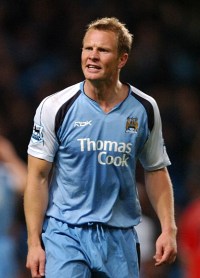
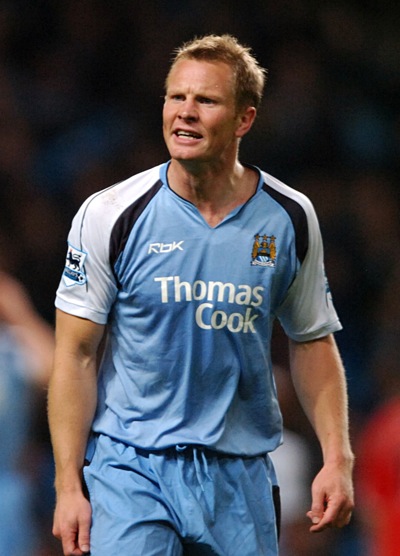
Ben Thatcher, Manchester City
<III>
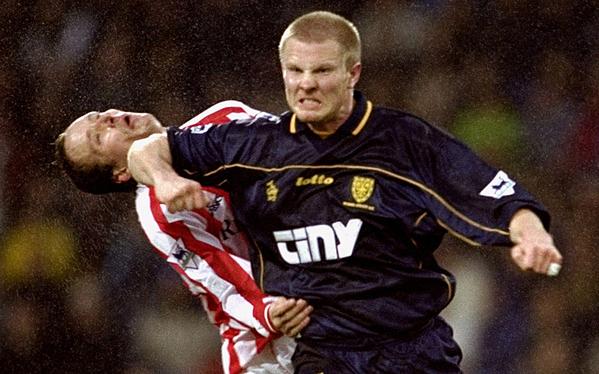
I’m the most terrific liar you ever saw. It’s awful. When I want to, I can charm the birds out of the trees. When I threw an elbow at Wimbledon, I denied it wholeheartedly and JFK just nodded and told me to get the hell out of his office. I caught the guy right in the face; he’d been riling me all game and I didn’t even look behind me as I did it. It was a good shot but I felt sorry as hell about it later. That temper of mine, it can really get me into trouble.
When Hughesy asked me if I wanted to play for Wales, I thought back to Vinnie and I told him it would be a dream come true. I told him that I’d been really close to my grandma and this would mean the world to her, God rest her soul. I told him I’d spent some lovely summers there as a kid, some of the best of my life. In fact, I’d only met her once and knew nothing about her. But the chance to play international football, and with Giggsy and Gary Speed no less, was too much. Hughesy nodded and told me he’d be in touch.
I made my debut against Hungary and we won 2-1. It was a fiery match in Budapest and I got a real bang out of that. The tackles were flying and I picked up a yellow on the half-hour mark. Robbie Savage looked over admiringly – that’s what I was there for, no doubt. ‘Ben Thatcher, international footballer’ – that had a nice ring to it.
It was all going swimmingly until Toshack took over. There was something about him that didn’t sit well with me. I think he resented me for not being Welsh – fair enough, I suppose, but I was a damn fine asset. Injuries and suspensions kept me away from the team, and I could tell that he was really questioning my commitment.
When Tosh called me up for the games against England and Poland, I was just coming back to fitness. I wanted to say yes, of course I did, but we had the Manchester derby three days later. Psycho made it clear that he needed me to start that game and it was hard to say no to him. So I had a hell of a decision to make.
‘Boss, I’m not recovering as quickly as I’d hoped. The injury is still playing up, so I’m not gonna be able to play. I’m bummed out about that.’
I felt damn sorry to have to lie to him. Old Tosh nodded and told me to rest up. I did but a few days later, he watched me play the full 90 minutes against United. We drew 1-1 at Old Trafford and I played pretty well but that wasn’t the point. After that, Tosh kicked me out for good.
<IV>
That’s all I’m going to tell about. I could probably tell you what I did after that – the last years at City, the year at Charlton and then the way I ended things at Ipswich with Keano. But I don’t feel like it. It doesn’t interest me too much anymore.
I work for a sports management company now. It’s nice, easy work and I have a lot of time to spare. Chris Perry keeps asking me if I’m going to apply myself, go back into football as a coach or something, but it’s such a stupid question. I mean how do you know what you’re going to do till you do it? There’s a reason they always called him ‘The Rash’.
‘You know what I’d like to be?’ I told him the last time just to shut him up. ‘I keep picturing this football field but instead of grass, it’s a big field of rye. Rye up to your knees, the kind of stuff that’s really hard to run through, and improves stamina no end. Hundreds of kids are running around, playing a massive game, and I’m on the edge of the pitch. What I have to do is shout encouragement, give them water, and stop the ball if it goes over the touchline. If two kids get a little hot and start to fight I have to come out and stop them. That’s all I’d do all day. I’d just be Ben Thatcher in the rye and all. I know it sounds crazy, but that’s the only thing I’d really like to be.’
Chris was quiet for a moment. ‘Thatcher, you’re a strange, strange boy. That just sounds like youth coaching on a large and pretty intense scale.’
I knew he wouldn’t understand. If you want to know the truth, I sort of miss the game, the fame, and the people. I think I even miss goddam Toshack and Hoddle. It’s funny.
Don’t ever tell your story. If you do, you start missing everything.
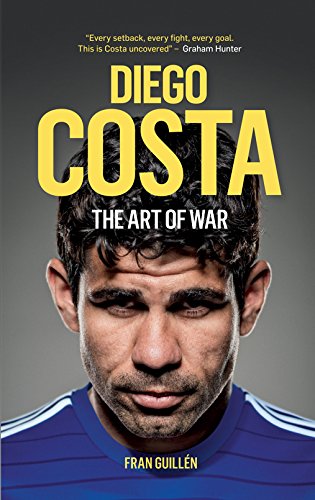 In my experience, football biographies can be even more disappointing than the autobiographies. After all, there is a higher level of expectation; these are books authored by chosen experts, rather than reluctant writers. At one end of the quality spectrum you have the unofficial biographies scrabbled together for the man of the moment; at the other, you have the insightful, often academic work of David Winner, Jonathan Wilson and Philippe Auclair. So where does Fran Guillén’s Diego Costa: The Art of War sit on this scale?
 Of Pitch & Page