The Game of Our Lives

The Game of our Lives: The Meaning and Making of English Football

By David Goldblatt

Penguin, 2014 

GoldblattDon’t be fooled by the St George’s cross and three lions on the paperback cover; The Game of Our Lives is high-brow, academic stuff. In seven chunky chapters, Goldblatt explores English football from a range of social science approaches – economics, sociology, urban studies, politics, anthropology, race studies, gender studies. With a reference section spanning seventy pages, this truly is an exhaustive look at our nation’s favourite past-time.

‘How has English football changed in the last 25 years?’ Despite dips into deeper history, this is the central question in The Game of Our Lives. Goldblatt is interested in ‘the intersection, where Britain’s deep-rooted cultural relationship with football met the arrival of new media and new money’. His findings, as you’d expect, evoke a unique blend of pride and shame. Cosmopolitanism, collective ownership and crowd safety fight to float above a murky world of greed, mismanagement and sexism.

While the early chapters on the financials of the Premier League era (player/agent power, club ‘growth without profits’) and the fight against racism may feel like fairly well-trodden territory, they’re written with the finesse and detail that you’d expect from the author of The Ball is Round. ‘Keeping it Real? Match Day in the Society of the Spectacle’, meanwhile, makes nice use of the blow-by-blow live football experience to theorise on the ‘longing for the communal and the public in an individualized and privatized world’.

The later chapters offer up more distinctive insights. ‘English Journey: Football and Urban England’ delivers an absorbing lesson in cultural geography. Bristol, Goldblatt argues, ‘perhaps more than any city cleared its inner urban neighbourhood of football’s traditional working-class social base.’ Working from north to south and from east to west, the conclusions are hard to refute. ‘Football at Twilight: Britain’s Endgame’ is a fascinating look at the ‘domestic fragmentation’ through the lens of football. Goldblatt starts with the shifts in Northern Ireland, Wales and Scotland before moving on to discuss ‘the English football nation’ and the fans’ rejection of the Union Jack in the late 1990s.

Perhaps even better is ‘Last Man Standing? English Football and the Politics of Gender’. ‘Is there any other realm of public life where prominent figures proclaim the essential, enduring maleness of their world?’ Goldblatt asks rhetorically. What follows is a study of both the slow, fettered progress made by women in the game but also the rise of the sophisticated foreigner and in particular the metrosexual man, embodied by David Beckham.

As you’d expect from what is essentially a series of intellectual essays, The Game of Our Lives can feel a little dry at times. However, there are certainly moments of crackling wit from Goldblatt, such as the description of TalkSport as ‘the saloon-bar bear pit of sports radio’ and his character assassination of the FA in Chapter Six (‘a hybrid of the punctilious provincial town hall and the clannish rotary club’).

As the sum of its scholarly parts, The Game of Our Lives puts football where it belongs – at the very forefront of our society. ‘The Church, the theatre, festivals and soap operas – football has acquired a place in British culture that exceeds them all, for it alone is the equal of each in their domains of ritual, performance, ecstasy and national narrative.’ At times, Goldblatt may seem a little serious, but his point is that the role and meaning of modern British football is no joke at all.

Buy it here
Up There

Up There: The North-East, Football, Boom and Bust

By Michael Walker

deCoubertin Books, 2014

51CE1dvjciL._SY344_BO1,204,203,200_As a very Southern boy, ‘Up There’ is exactly how I’ve always viewed the North-East. During my lifetime, the region’s biggest football clubs have yo-yoed between spectacular near misses and equally spectacular declines, with an ardent fan base the only real constant. This season, Middlesbrough are favourites for Premier League promotion, while Newcastle lost manager Alan Pardew to a team eight places below them in the table, and Sunderland have now sacked Gus Poyet after just one win in twelve games. It seems there’s never a dull day along the Tyne, Wear and Tees.

Michael Walker’s Up There: The North-East, Football, Boom and Bust is the definitive history that the region deserves, a combination of the untold stories and the stories that deserve to be told again and again. As with Promised Land, Anthony Clavane’s classic book on Leeds United, Up There is as much about social history as it is about football history. There is a noticeably separate identity in the North-East of England; ‘Part of that is distance, part of it was industry and part of it is political. Part of it is football.’

Where Clavane wove race, religion and literature into each era in turn, Walker chooses to set the social scene in one go, with first section ‘The Culture’. From the golden years of the early 1900s to the often grim reality of today, the North-Eastern decay is depicted in detail on several, inter-connected levels: money, jobs, community; the decline of coal mining, the decline of shipbuilding, the decline of local football.

With this backdrop established, that latter theme becomes the focus, as Up There takes a footballing journey from Bob Paisley through to Mike Ashley. Childhood neighbours turned arch rivals, Brian Clough and Don Revie; the Charlton brothers, perhaps the most famous Geordies to fly the nest; and, of course, Alan Shearer’s second coming on Tyneside. The thread that links these three narratives, and many more according to Walker, is exodus – talent born in the North-East, but sadly most successful elsewhere.

The later, modern sections are brilliantly and succinctly done. In around 20 pages, Walker tells the exhilarating story of Middlesbrough’s last 20 years, from Juninho all the way to Aitor Karanka. Conversations are used as key structural devices – the words of Newcastle’s Rob Lee and Sunderland’s Niall Quinn work very well as pivots for the highs and lows that surround them. Up There even manages to cover the lower tiers, with chapters on Hartlepool, Gateshead, Darlington and the Northern League.

Carefully researched and thoughtfully structured, Up There is also very well-written. Walker is highly skilled at combining the best aspects of short-form journalism (anecdotal details, insightful interviews, concise scene-setting) with a more literary eloquence. ‘If there is a constant down all the years at Newcastle, it is the milking of devotion’, Walker argues at one point. Later on, he describes Quinn as ‘a worried man. Wearside had a few of them, its talking wounded.’ The style feels perfectly suited to the subject matter, a rather bleak kind of beauty. With writing like this, perhaps the North-East won’t always be quite so ‘overlooked’.

Buy it here

The Club

The Club: Living the dream at the bottom of English football

By Simon Akam

Newsweek Insights, 2015

The ClubThe worrying growth of inequality in the UK over the last 30 years is something that we’ve heard a lot about recently, and that the situation has been replicated in English football is not news to anyone either. Television revenues have enabled the Premier League rich kids to push their salaries through the roof, from £75 million in 1991-92 to £1.87 billion in 2012-13. In 2012-13 the average Premier League club received £60 million in television revenue, while clubs in the fourth tier of English football, Sky Bet League 2, received just one hundredth of that amount. However, despite these historically high levels of disparity, there is still more money in the lower leagues than ever before and this is the world that Simon Akam investigates in The Club.

At League 2 side Luton Town, Akam is given full, behind-the-scenes access to players, facilities, fans and non-playing staff. We get to visit the training ground and meet the club physio, Simon Parsell, who treats players in a portakabin and bemoans the lack of top-quality resources to treat his players. Similar stories are brought forward by the club’s groundsman and Head of Catering; for all their dedication to their roles, there is a frustration regarding the constraints that they face due to limited funds.

There’s little surprising about this so far but the interviews are interesting in themselves and the scenes which Akam describes make for a thoroughly enjoyable read. On the training ground Akam joins in with practice, before quickly falling away when he is unable to keep pace with the athleticism of the League 2 players. In another portakabin, a humorous scene takes place as an electricity meter reader, a Luton fan, overstays his welcome. As Akam notes, ‘the high god of banter’ needs sacrifices. Perhaps best of all is the club’s young data analyst bravely attempting to persuade Luton manager John Still to buy better equipment, battling on in the face of sweary hostility.

In the book we meet some of the players who emerge from a wide range of back grounds. Higher league cast-offs, lower league journeymen, and ex-builders making their way in professional football for the first time; these are the men playing what Akam rather poetically describes as somewhere ‘between the gutter and the stars’. We meet club captain Stephen ‘Sumo’ McNulty and go jeans shopping with Jonathan ‘Smudge’ Smith and Danny ‘Fitz’ Fitzsimmons. In a look at the celebrity status of footballers at this level, we also meet one of the girlfriends, former S Club Junior member Stacey McLean.

Next up for Akam is the social makeup of the club’s support. Luton has a large Asian population on its doorstep and The Club looks at what Luton Town means to them. Alongside the well-known rationale – Asians prefer cricket, prefer to watch matches on TV, don’t like standing in the cold – are some interesting insights. An unknown source suggests that initial racism alienated fans from football over the past decades, and while work has been done since to improve relations, large-scale Asian support would only come when a local Asian player became successful at the club. On the opposite end of the scale, an interview with EDL founder and life-long Luton fan Tommy Robinson makes for interesting reading.

The one small gripe I have with The Club is that though it offers an insightful snapshot of life at Luton Town, it is just a snapshot of lower league life, and not an in-depth study. In fairness to Akam, that would have been beyond his remit here but many issues which he touches on could be the focus of research in their own right. Akam spends just a week at the club in the first instance, returning 6 weeks later for a second trip. Another issue is Luton’s unsuitability as a lower league example. The Hatters missed out on the Premier League by just one season, having been relegated in 91-92. In terms of stature, Luton Town would not be out of place in the Championship, and funds are available to offer some players up to £75k per year. Sadly, Akam’s approaches to Mansfield Town, Hartlepool United, and Morecambe FC, who collectively have managed just one season in the second tier between them (Mansfield in 77-78), were declined.

Ultimately though, The Club is an enjoyable and interesting look inside a lower league football club, and surely a must for any Luton Town fan. In what is a short book, Akam covers a wide range of lower league issues, not least the financial risks being taken by everyone including the players. Many leave secure jobs to embark on what is increasingly a very unstable career as a professional footballer. However, financial remuneration is better than ever before, minor celebrity status is achieved (in the locality at least), and the chance to play every Saturday, ‘somewhere between the gutter and the stars’, is something that most football fans would still do in a heartbeat… wouldn’t you?

John Mottram

Buy it here

Rock ‘n’ Roll Soccer

Rock ‘n’ Roll Soccer: The Short Life and Fast Times of the North American Soccer League

By Ian Plenderleith

Icon Books, 2014

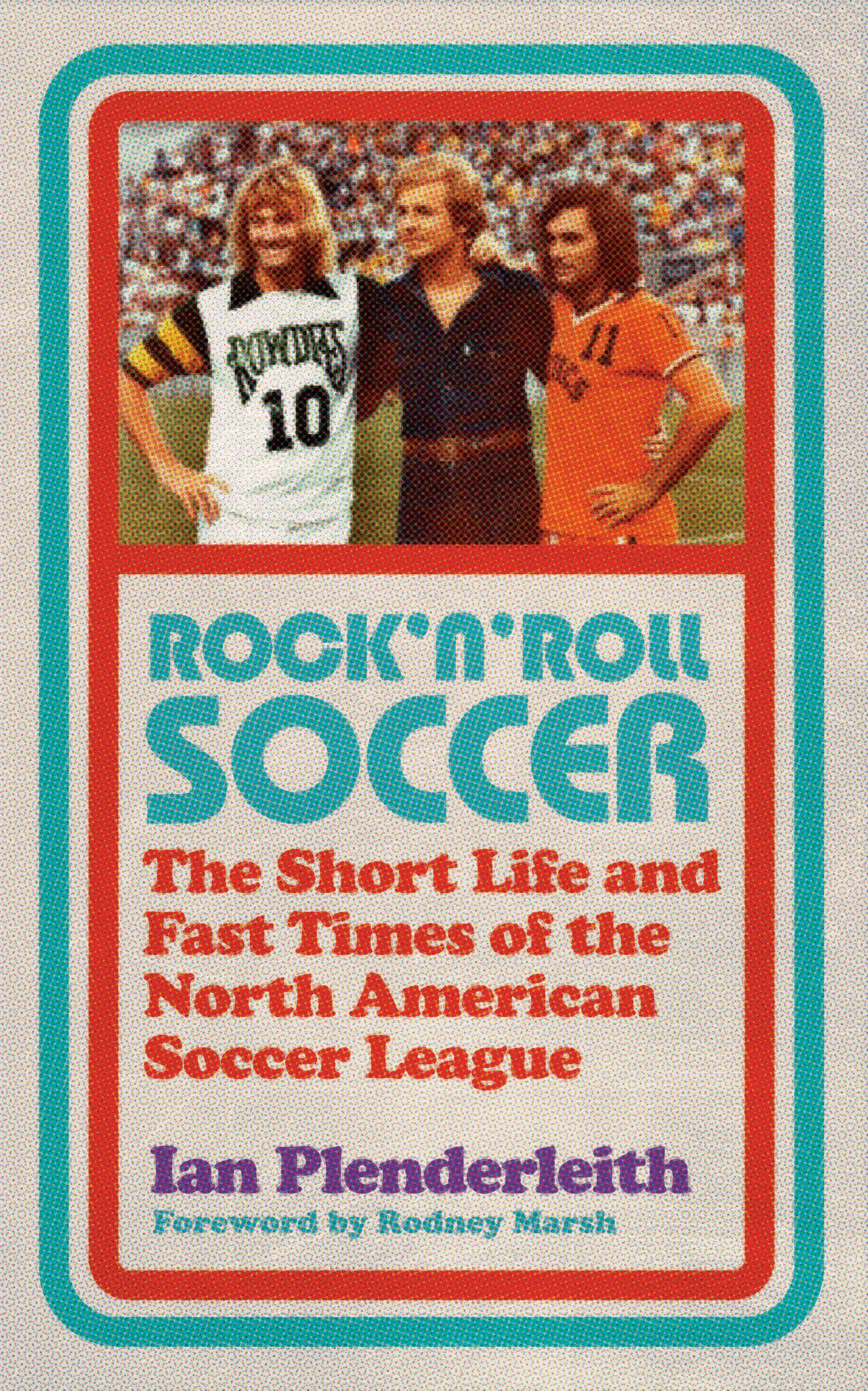
9781906850722In the last year, the MLS has recruited Kaka, David Villa, Frank Lampard, Steven Gerrard and Sebastian Giovinco. It’s not a bad haul of modern talent but it’s hardly Pele, Beckenbauer, Eusebio, Cruyff and Best. To think that five of the very best players of all time played in the US in the 1970s is hard to imagine, no matter how old and injured they were. But then, the North American Soccer League (NASL) as a whole was a pretty unbelievable concept, and that’s why Ian Plenderleith’s Rock ‘n’ Roll Soccer is such a brilliant and necessary read.

Between 1968 and 1985, America made an audacious move into the ‘soccer’ market, putting a very local spin on the more traditional European game. The maverick NASL served up cheerleaders, 35-yard shootouts, ‘blatant commercialism’, and plenty of sex, drugs and rock ‘n’ roll – entertainment, in other words, or ‘a good circus’ as one New York Cosmos player describes it. FIFA didn’t like it one bit, but for a while, the people of America seemed to. Rock ‘n’ Roll Soccer is a hugely enjoyable, anecdotal trawl through the ‘crash and burn’ history of the league.

It’s one big Shakespearean tragedy, a tale of ridiculous over-expansion, where clueless owners like Jimmy Hill, Milan Mandarić and Rick Wakeman interacted with the player power of old pros like Pele, Cruyff and Eusebio with his ‘one knee that looked like Mount Everest’. The true superstars in Rock ‘n’ Roll Soccer, however, are the American players who got wrapped up in the circus and lived to tell the tales. Best of all is Bob Iarusci, who was a teammate of all three during his eventful NASL career, and has a thing or two say about them.

Plenderleith’s tone and structure is a great fit with the subject matter. Rock ‘n’ Roll Soccer is full of amusing asides and dry wit, from the chapter titles – ‘Debit does Dallas’, ‘Learning from your alcoholic dad’ – right through to the ‘Fun Facts’ sections for each season. But best of all is the ‘Half-time’ lists section in the middle of the book, which features ’20 odd names in the NASL’ plus the ‘NASL Soundtrack’.

Not that the book is all fun and frolics, however. Plenderleith writes very well on the social background to his stories, whether that be Washington DC or, more significantly, Britain. Many players, he argues, ‘fell in love with the country and its beaches, its possibilities, its openness. They escaped the claustrophobia of a socially conservative society.’ Especially for born entertainers like Rodney Marsh and Frank Worthington, the relaxed glamour and showbiz of American soccer was a marked improvement on the dull tactics and hooligan fans back home.

The book’s second line of argument is that the league was a prototype for football as we know it today. ‘The NASL introduced the idea that a soccer game could be an event and a spectacle, not just two teams meeting to compete for points’, Plenderleith contends. 3 points for a win, 3 substitutes, the backpass rule, names and number on shirts – all these innovations started with the NASL. The first experiment rarely gets the recipe right but it’s hard to disagree that ‘the biggest leagues on the planet became extensions of what the NASL had begun.’

Rock ‘n’ Roll Soccer takes a relatively unknown area of ‘soccer’ history and brings it to life in all its spectacular glory and failure. Sure, there’s a little bit of excess (the book’s over 400 pages long) but what would you expect? This is rock ‘n’ roll after all.

Buy it here

Vertigo

Vertigo: Spurs, Bale and One Fan’s Fear of Success

By John Crace

Constable, 2014

VertigoWe’re approaching a quarter of a century since the publication of Fever Pitch, and yet it remains virtually unchallenged as the benchmark for football fan literature. In the decades since, authors have tended to tread lightly or skirt the genre altogether, as if this central, highly subjective and ever-changing aspect of the sporting experience already has its definitive description. Thankfully, some do dare to disagree and who better to challenge Hornby’s tales of Arsenal than a supporter of their North London foes? In Vertigo, Guardian journalist John Crace has written an entertaining account of what it is to be 1) a football fan and 2) a Tottenham fan. Over the course of the club’s 2010-11 season, we’re treated to several highs (Gareth Bale vs Inter Milan), a few lows (away trips to the Midlands) and a hell of a lot of the irrational inbetween: anxiety, paranoia, pessimism.

Like Fever Pitch, Vertigo is in many respects one long, valiant response to that age-old question, here posed by long-suffering wife Jill – ‘How come you get so much pleasure out of something that gives you so much pain?’ Crace’s answer has two main strands: one universal, the other very individual. The first is the sociable aspect of football fandom, that much-eulogised sense of ‘belonging’. Vertigo is as much about the characters in the stands as it is about ‘Crouchie’, ‘Pav’ and ‘Hudd the Thudd’ on the field. Robbie, the self-conscious, teenage son finding his terrace voice; Justin and Amici the ‘football next-door neighbours’; Trevor and Simon, advisors on all things memorabilia; and best of all Matthew, optimist and narcoleptic father of twins with an unfailing love of Journey and ‘Yacht Rock’. This is Crace’s football gang, the friends with whom he shares every eventuality, and with whom he shares the Tottenham psyche: sceptical of success, welcoming of bitter disappointment.

Speaking of psyche, the second strand of the author’s answer is more unusual and more interesting for that very reason. ‘For those four hours Spurs have my undivided neurosis’ – Crace is very candid and eloquent when discussing his history of mental health issues, and describes the beautiful game as an ‘escape from myself’ as well as a ‘constant endurance test of proving to myself that I can stick with something through both good and bad’. Football also touches on several key relationships in his life – with Robbie, but also with his daughter Anna and his sister Veronica. As Crace concludes with a rare and touching ray of positivity, supporting Tottenham ‘helps me navigate my life.’

As you’d expect from the author of Digested Read, a wry, cutting humour prevails. Crace is a master of pithy one-liners – football is ‘like going to a health spa. Only without the pampering’, ‘Any day when Spurs are playing is better than one when they aren’t. Until kick off’. He is spot-on when it comes to the players – my personal favourite is ‘banker for the catastrophic’ Younes Kaboul  – and spot-on when it comes to the club, ‘a team whose fans grandiosely talk of ‘The Spurs Way’ as a metaphor for attacking, stylish football as we slide to yet another 4-3 defeat’. Thankfully, Crace is also ever-willing to poke fun at himself; the chapters on his souvenir collecting (tickets, shirts, programmes, cup celebration banquet menus) are self-mockery at its best.

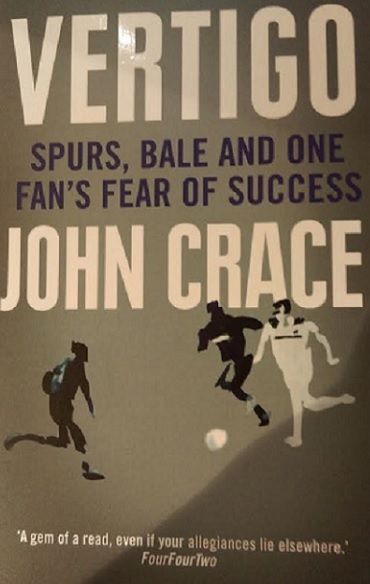
My one gripe with Vertigo relates to the paperback update. Richard Swarbrick’s brilliant cover illustration can’t hide the fact that a book published in late 2014 has a preface from 2013. So where you might hope for Crace’s considered views on the sale of Bale and Sherwood’s tenure, instead you find ‘When AVB moves on or is moved on…’ This small grumble aside, Vertigo offers up a well-written and highly enjoyable blend of personal and sporting narrative that should find a much wider audience than just the Spurs faithful. Gooners might not like it but Fever Pitch now has a worthy, contemporary bookshelf rival.

Buy it here