Fear and Loathing in La Liga

Fear and Loathing in La Liga: Barcelona vs Real Madrid

By Sid Lowe

Yellow Press, 2013
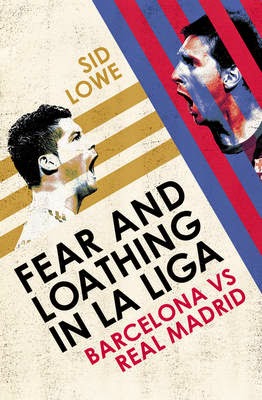
With Atletico Madrid winning La Liga this year you can forgive Sid Lowe for finding their success a bit of a nuisance. Having written about the rivalry of the second and third-placed teams, he recently tweeted, tongue firmly in cheek, that his book was ‘pointless bollocks’. Fear and Loathing in La Ligais in fact neither pointless nor bollocks, especially after Real Madrid’s ‘La Decima’ triumph in Europe. Instead it’s an informative, engaging, and enjoyable look at what remain Spain’s two biggest clubs. The success of Atleti this year has been astonishing, and their efforts in breaking the Barca-Real duopoly only further highlight the dominance of the big two in the past decade and throughout the history of the Spanish game. Atletico are still a long way behind as the third most successful team in the history of the Spanish league, winning only their 10th title compared with Barcelona’s 22 and Real’s 32. The last nine winners of the Ballon d’Or plied their trade at these two giants, and they are the two clubs with the most Champions League trophies since the competition’s rebranding in 1992. Individually, Barcelona and Real Madrid are both European giants; but as enemies, they’re the most famous clubs in the world.

From the start Lowe is keen to highlight the complexity of the rivalry, dismissing the common-held dichotomies: Madrid bad, Barca good, Madrid facists, Barca freedom fighters. Dealing with the common accusation that Madrid were Franco’s team, for example, Lowe points out that the city of Madrid suffered greatly through, and as a consequence of, the Second World War, and that the club that emerged was weak and failed to win a single league title in the first 15 years of Franco’s dictatorship. Not that Barca’s ‘victim complex’ is without some foundation; the controversial 11-1 Copa del Generalissimo defeat in 1943 is explored in detail, and the sole surviving member of the Barca team from that day tracked down and interviewed about the military intimidation. Lowe’s considered argument is that the establishment’s support of Madrid was a result of their success rather than the cause of it. A government seeking international recognition needed popular representatives and Real with their five consecutive European Cup victories in the late 1950s embraced their role as ‘the best embassy Spain had’. This level of balanced analysis is found throughout Fear and Loathing, as Lowe sifts through the mass of myth and folklore.

The rivalry – and thus the book itself – is also full of interesting parallels and contrasts. Both clubs lost their Civil War-era presidents to the Republican cause but whereas Barca’s Josep Sunyol became a martyr figure, Real’s Rafael Sanchez Guerra is largely forgotten. Barca’s ill-fated appointment of the original ‘Special One’, Helenio Herrera, to break Real Madrid’s dominance, is mirrored fifty years later by Jose Mourinho’s unsuccessful attempt to oust Guardiola’s Barcelona. In the transfer market, the constant attempts to outdo each other turn out to be nothing new. For Neymar and Gareth Bale in 2013, think the likes of László Kubala and Alfredo Di Stéfano in the 1950s. If anything, the rivalry is less hostile today; the Spanish government was forced to intervene in the Di Stéfano saga.

In amongst these stories, the sheer breadth and depth of research is plain to see. Lowe, an historian by trade, trawls the archives to uncover fascinating documents about the Di Stefano transfer and Sunyol’s death. He also gains unprecedented access to many of the protagonists in each club’s story – Zidane, Di Stefano, Cruyff, Iniesta, Joan Laporta, and best of all Figo, who offers a very interesting insight into his (in)famous transfer between the two clubs. Lowe has stated that he had to trim about a third of his original draft for the book and that would certainly explain the sparse references to greats such as Maradona, Henry and Gravesen. Here’s hoping for a director’s cut to further the education.

All in all, Fear and Loathing is a great achievement and a very worthy addition to the Spanish football canon. It’s accessible and full of facts and anecdotes that will be new to even the most knowledgeable of football fans. One often gets the sense from reading Lowe’s articles and listening to his contributions on The Guardian’s ‘Football Weekly’ podcasts that he tires of reporting on these two Spanish giants but that doesn’t come across in this book at all. The Michu epigraph – ‘Barcelona or Madrid? Oviedo’ – highlights Lowe’s awareness that though this rivalry does dominate Spanish football, it’s not the be-all and end-all. Though hopes of a book about Getafe and Valladolid’s rivalry are slim, one does hope that we see another Sid Lowe masterpiece in the not too distant future.

John Mottram
Buy it here

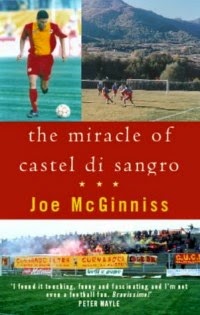
The Miracle of Castel di Sangro

The Miracle of Castel di Sangro

By Joe McGinniss

Sphere, 2000

There are many things I’d trust my brother with but a book recommendation wouldn’t usually be one of them. Yet around the turn of the century, in between Dan Brown-type thrillers and Poirot-lite whodunnits, he read an intriguing book about an American who spent a season in a tiny Italian town following the fortunes of a lower league football team. To this day, it remains his favourite book – he even faked Joe McGinniss’ autograph on the title page of his well-thumbed copy. Sadly, in my ignorant snobbery I consigned it to the slush pile alongside the great literary works of Ashley Cole and Wayne Rooney. Oh, the mistakes of youth.

How times have changed. Now I can’t stop reading football books and I celebrate McGinniss, God rest his wonderful soul, as a hero in the Hornby tradition. A brilliant writer delving deep into an obsession – surely that’s the noblest of pursuits. Like all the sporting classics, The Miracle of Castel di Sangro is about a whole lot more than a game. It may start out as a footballing endeavour – from Roberto Baggio at World Cup 1994 to remote Abruzzo and a ‘miracle’ journey all the way from C2 to Serie B – but it soon becomes apparent that ‘the ninety minutes of calcioplayed each Sunday were having less and less to do with my experience of Castel di Sangro’.

Instead, it’s about the many characters he meets along the way: the mysteriously silent owner Pietro Rezza, the sharp-tongued manager Osvaldo Jaconi, the team’s mother and number 1 fan Marcella, and that’s without naming a single player. And they, after all, are the leading actors here, displaying the kind of dignity and spirit that superstars can only dream of. I can’t begin to do them justice here but as promotion hero Pietro Spinosa tells McGinniss, ‘a squad like this – and I speak not of talent but of the cuore e grinta e carratere … this is once in a life, and once only … And for you, Joe, to pass the season among these kinds of men – quello è il vero miracolo.’

Alongside character in spades, there’s Hollywood-style action. Castel di Sangro contains all the elements of a page-turning thriller; it’s a will-they-won’t-they rollercoaster ride with subplots of corruption, sex, drugs and death. But then this is Italy, where football and power are bedfellows, with the Mafia reigning supreme over mere mortals. And where a hotel can completely close for a day and a football team can play half a season without a home stadium. Many of the books most interesting and entertaining sections show McGinniss coming to terms with ‘the richness of the life I led as a stranger in a strange land’.

Or attempting to, anyway. One thing McGinniss is not is a shrinking violet; having left his family behind in America for a year of unadulterated obsession, he expects answers to even the most difficult of questions. This brave, partisan stance makes for brilliant reading, as he harasses his neighbour Jaconi about the negative tactics and stubborn team selection, and confronts club president Gabriele Gravina about the misuse of funds. But despite the frequent farce surrounding him, McGinniss never loses his sense of humour, or ‘la potenza della speranza’. For every day of disillusion, there’s an equal and opposite moment of exultation. This is a book about football, after all.

Castel di Sangro is the kind of story you never want to end, showcasing football at its humane best. To quote defender Luca D’Angelo, ‘Serie B – never a dull moment except during the ninety minutes of the match!’ A film could never do it justice, but McGinniss certainly has. My eternal thanks to him and, of course, to my brother.

Buy it here

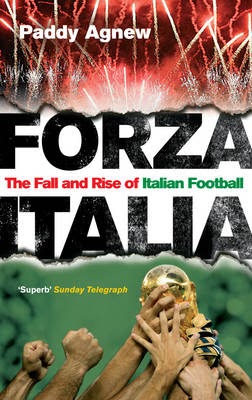
Forza Italia: The Fall and Rise of Italian Football

Forza Italia

By Paddy Agnew

Ebury Press, 2007

June 2006 was a strange old month for Italy. As the Azzurri silenced their critics with a World Cup final win, their domestic game was brought to its knees by one of the biggest corruption scandals in football history. For resident reporter Paddy Agnew, this duality was neither new nor surprising; in fact, it formed the perfect conclusion to his update of this book. After all, June 2006 was the ultimate demonstration of Forza Italia’s overarching narrative: the conflicting elements within the national sport, and thus the nation. The ‘cynical skill, occasional artistry, careful organisation and inspired coaching behind the World Cup win in Germany’ at odds with the ‘duplicity, cunning, and attempted cheating that characterised Calciopoli’. Here lies the fascination of Italy.

It is with good reason that Forza Italia promotes football (calcio) as a ‘unique looking glass’ through which to examine Italy. The founding years of Serie A is the story of Mussolini and his legacy; the Maradona soap opera highlights the central, shadowy role of the Mafia; and the AC Milan glory years of Van Basten, Gullit, Maldini and Baresi help to explain Berlusconi’s controversial rise to power. Even the ‘deadly, upmarketedly serious’ reporting surrounding Sven-Göran Eriksson and his resignation from Lazio reflects a media culture that is (perhaps at times too) happy for the private to stay private. Each story presented reaffirms the fact that the two cannot be separated; ‘football is not so much Italy’s national sport as a virus woven into the DNA of the average Italian’. And the negative connotations of that word ‘virus’ often prove apt. Corruption, racism, sexism, cronyism and economic decline – all are present and correct in this well-curated sweep of a sport and a country. Yet thankfully Agnew remains a good-natured tour guide, full of open-eyed affection for the eccentric ways of his adopted homeland.

In the world of non-fiction writing, tone is always a tricky but crucial balancing act. Too personal and it becomes light-hearted travel writing; too political and it becomes weighty history. Agnew is clearly aware of these dangers; in his introduction, he rejects the notion of ‘an academic or sociological survey of Italian football’, calling Forza Italia instead ‘a personal reflection on 20 years of football-watching’. Well it is and it isn’t. Alongside the football, the early chapters cover his acclimatisation in Rome and subsequent relocation to the village of Trevignano, offering up the kind of quirky sketches found in Tim Parks’ writings on Verona. Agnew presents a country where it takes six weeks to bank a cheque but there’s a hierarchy of experts (espertos) in the local bar – ‘This was football, a serious business, and seats had to booked.’ A country where a wily rural builder called Bruno can buy ancient Roman steps for the price of ‘300,000 old lire, plus 20 fish.’

But as the book approaches the 21stcentury, these musings on Italian life fade away, replaced by an account of Italian football’s fall from grace, scandal by vicious scandal. We see its reputation tarnished by doping allegations, match-fixing, fan violence and the bribery of match and league officials. By 2006, Agnew explains, Italian football ‘like Italy itself, is stuck in a moment and does not know how to get out of it’. The detail in these chapters is impressive, the analysis insightful but on these subjects Forza Italia cannot, and should not, compete with John Foot’s nearly 700-page definitive history Calcio, unfortunately published in the same year. It’s the charm of Agnew’s own story that makes Forza Italia particularly compelling. With this in mind, perhaps its spirit would have been better served by a collection of articles, each passing from personal observations, through football, to address a larger, Italian issue.

As it is, sadly the football also gets lost amidst the minutiae of corruption. It comes as something of a shock to find the brilliantly pithy statement ‘Italian football…is different because, along with skill comes caution’ in the coda to the penultimate chapter, after lengthy discussions of everything but the beautiful game itself. Agnew’s nostalgia for the glamour of the late 1980s and early 1990s – a time when ‘the game’s subtle skills commanded respect and knowledgeable admiration and where you could watch football in some style’ – is reflected in the early impassioned portraits of Liam Brady and Maradona. But after the commendable defence of Pippo Inzaghi in Chapter 6, very few players are given more than cursory name checks. Totti, Del Piero, Ronaldo, Zidane? Unfortunately only mentioned with regards to their roles in scandal. Please excuse the cliché, but Forza Italia really is a book of two halves.

Buy it here

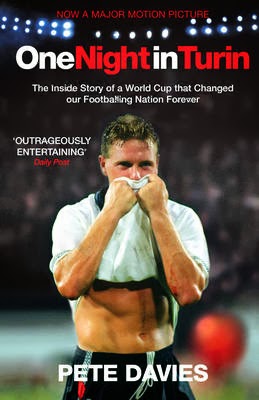
One Night in Turin

One Night in Turin: The Inside Story of a World Cup that Changed our Footballing Nation Forever

By Pete Davies

Yellow Jersey Press, 1990

Ahead of this summer’s World Cup in Brazil, every England fan should be prescribed a copy of One Night in Turin. It may be nearly a quarter of a century since Italia 90, but ‘Ghastly press, oafish fans, and 4-4-2’ is a summary that still rings true enough. This year, a Gazza-esque hero will rise and a Psycho-esque villain will fall. The FA is still run by octogenarians ‘bereft of common sense or ideas’, our newspapers still prefer to vilify than to praise, our national side is still dominated by brave but unspectacular grafters, and disappointment, penalties and heartbreak are all still guaranteed.

But A Night in Turin itself is an absolute one-off – no football writer will ever again get the kind of total access that Pete Davies had to Bobby Robson and his England team. Because in 1990, at the dawn of the agent-led, commercial era (or ‘Logoland’ as Davies calls it), it’s clear that the tension between press and players is already at breaking point. For Gascoigne, the epitome of the modern footballer, no money equals no comment. His reason? Simple: ‘I hate the press’. Luckily, Davies isn’t the press, as he has to remind his wary (and weary) subjects frequently. He may not be the most skilled of interviewers – ‘What would you be if you weren’t a footballer?’ and ‘What’s it like to score a goal?’ are his go-to questions – but Davies is in a position to offer a tantalising taste of the boredom and claustrophobia but also the ‘shared, sealed, exclusive group cohesion’ of the England camp.

Often you read ‘behind the scenes’ and are disappointed by the supposed ‘insight’. Not here – ‘off the record’ chats with the likes of Butcher, Lineker, Barnes and Waddle are peppered throughout the superb tournament analysis. These players might have nothing to say to the papers but they’re surprisingly forthright with Davies. The frustration of Barnes and Waddle with the negative, skill-stifling tactics is particularly telling; ‘They don’t say to Baggio or Hagi or Gullit, we want you back defending’, moans the latter. But perhaps best of all is the portrait of their much maligned manager. Much has been written on Bobby Robson but little can be as succinct as ‘he loved to win, he was desperate to win – but he was at least as much terrified of losing’.

In terms of style and tone, Davies hits the nail right on the head, bridging the gap between the tabloid journalism he rails against and today’s rising intellectualism. Like Nick Hornby, Davies is a football fan first and a writer second. One Night in Turinis an informal, bawdy, yet eloquent version of events, as entertaining as the ‘Planet Football’ it so lovingly describes. Humour is key to the approach – FA Chairman Graham Kelly is ‘a complete charisma bypass’, ‘you only had to show Caniggia (striker for Argentina, the team Davies saves his best vitriol for) the laces on your boot, and he was into a triple somersault’ and Bologna has ‘all the festivity…of a bad day in a bread queue’. Along the way we’re shown the funny side of tacky merchandise, bad sandwiches, Italian bureaucracy and sleepless nights in airports and train stations.

Serious comment, though, is never far from view – positioned between the team, the fans and the journalists, Davies is commendably objective, particularly on the central issue of English fans abroad. His balanced conclusion – that a thuggish minority, egged on by the trigger-happy media, scared the Italian police into an over-reaction, which in turn endangered the (largely) innocent majority – really stands the test of time.

As a title, One Night in Turin does the book a real disservice. Only the final 20 pages are dedicated to the semi-final against Germany, the last of the 21 chapters. Neither is this simply a book on England’s Italia 90 campaign; over 200 pages have passed before their first game against Ireland begins. Instead, as the original title alludes to, the perspective is much broader; football, travel, culture, and most significantly a snapshot of a nation. Davies’ argument is that hooliganism is not simply a football problem, but rather a reflection of our society at large – ‘the picture develops of a predominantly young, white, urban, male section of England’s following whose home environment…is, culturally, economically, politically, morally, all played out’.

Buy it here

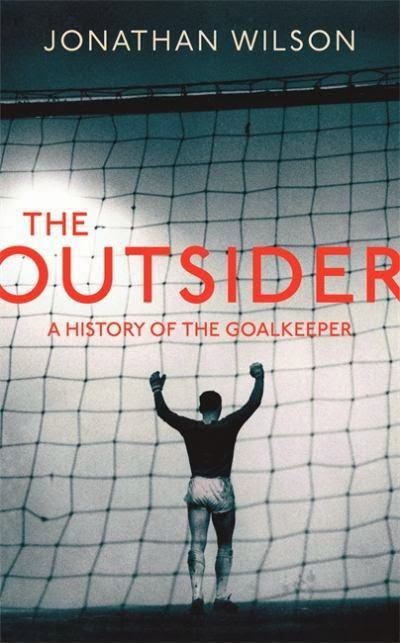
The Outsider: A History Of The Goalkeeper

The Outsider: A History Of The Goalkeeper

By Jonathan Wilson

Orion, 2013

‘He is the lone eagle, the man of mystery, the last defender’ – unfortunately, history hasn’t always shared Vladimir Nabokov’s romantic vision of the goalkeeper. Until the Twentieth Century, he was an ‘unspoken other’ – goalkeepers only started wearing different shirts in 1909 – and according to football writer Jonathan Wilson he ‘is doomed always to be an outsider’. Distrust and disregard have long surrounded a role burdened with the ultimate, decisive responsibility and ‘all its potential for greatness’. Powered by this paradox, The Outsider relates a fascinating narrative arc from ridicule to recognition, from alienation to reintegration.

Each chapter is a case study analysing a different topic, whether that be geographical (Russia, Africa, South America, Britain, USA) or stylistic (‘The Sweeper-Keeper’, ‘Land of the Giants’, ‘The Fear of Penalties’), or both. But at the heart of each country and each technical phase, Wilson demonstrates, are the same core goalkeeping debates – reactive shot-stopping vs proactive sweeping, reflexes vs anticipation, calm solidity vs risky extravagance, strength vs agility, aggression vs composure, ‘the stoics who quietly absorbed the punishment, and the extroverts’. The Outsider is a celebration of the variety of skillsets that have graced the goal, even if it concludes with the progression towards a more rounded approach in the new generation led by Iker Casillas, Manuel Neuer and Hugo Llloris; ‘it’s rare now to find goalkeepers who don’t both command their box and feel comfortable with the ball at their feet as well as having a basic competence at saving shots’.

The many goalkeeper profiles in the book present some interesting common denominators, including a beginning as an outfield player and a background in athletic, dextrous sports such as handball (Peter Schmeichel), volleyball (Buffon, Taffarel) or basketball (Brad Friedel). And, of course, there are also more obvious core parallels, such as confidence, bravery and mental toughness, or as Serbian keeper Milutin Šoškić puts it, ‘a goalkeeper must be hard with feelings’. Wilson is an impressive curator and historian but where both he and his book excel is in the realm of investigative journalism. The chapters where he goes in search of his own answers are particularly compelling, as he interviews the great Cameroonian rivals Thomas Nkono and Joseph-Antoine Bell, for example, or America’s coaching guru Šoškić and Steau Bucharest’s shoot-out hero Helmut Ducadam.

This is sports writing for the stout of heart and mind. In Wilson’s highly capable hands, a history of goalkeeping becomes a history of football and even, at times, a small-scale modern world history. The keeper is placed at the centre of concentric circles of ‘perception’: football, culture, geography, politics, history, philosophy, literature. Be prepared for Nietzsche and discussions of ‘the dissonance between the apparent simplicity of the signifier and the complexity and layered meaning of the signified’. But this scholarly approach, as Wilson explains, is a fitting tribute to a role that has often been linked with the artistic temperament – ‘individuals, not necessarily intellectuals, but at the very least people who think for themselves’.

It’s hard to find fault with such a comprehensive study. Perhaps the slightly odd positioning of a chapter on Lev Yashin and the Soviet tradition in between chapters tracing the largely British pre- and inter-war history? For the most part, though, Wilson knits together theme and chronology nicely by picking out stand-out figures (Van Der Sar, Buffon etc.) and then retracing their national histories. Occasionally, however, this approach does throw up puzzling results, such as the equal coverage for IFFHS’ second best goalkeeper of all time, Dino Zoff, and virtually unknown Ghanian Robert Mensah. The lack of technical detail regarding the Italian great is noticeable, but The Outsider sticks to its storytelling guns throughout, sometimes prioritising eccentric anecdotes over conventional (and much-repeated) biography. As Wilson explains in the prologue, this is ‘not an encyclopaedia of goalkeeping’.

And that’s the only minor drawback; for all its tremendous scope, The Outsider remains a selective study, where lengthy discussions of book and film plots and historical anecdotes do occasionally crowd out insight. The psychological angle in particular feels frustratingly underdeveloped, or at least unassembled. Except for scattered references to goalkeepers with ‘a shadow across his soul’, the issue only really comes into focus during the final chapters covering Buffon’s depression and Oliver Kahn’s mid-life crisis. Goalkeepers yo-yo between the very extremes of life; as Wilson puts it, ‘No sportsman, surely, so regularly confronts the arbitrariness of the fates.’ As well as those forever haunted by high-profile mistakes, we’re told of many great goalkeepers who recovered from early setbacks: Yashin, Gilmar, Frank Swift and Gordon Banks to name but a few. But how? Perhaps, despite Wilson’s sterling efforts, the goalkeeper will always remain that ‘man of mystery’.

Buy it here