Gareth R Roberts interview

Football Fiction with Gareth R Roberts, Danny Rhodes + Martin Greig

Waterstones Deansgate, Manchester

This weekend, I was in Manchester for their inaugural Football Writing Festival, a fantastic labour of love organised by Waterstones Deansgate in association with The National Football Museum. 9 days long (4th-12thSeptember), it comprises 10 amazing events featuring the leading lights and luminaries of football journalism including Jonathan Wilson, Matt Dickinson, Sid Lowe and Graham Hunter. After a fascinating insight into the world of sports biography and newspaper writing with Paddy Barclay, Mike Calvin and Ian Ridley on Friday night, I spent Saturday afternoon absorbed in the less-celebrated world of sports fiction. Gareth R Roberts (author of What Ever Happened To Billy Parks?) Danny Rhodes (author of Fan) and Martin Greig (co-author of The Road To Lisbon) shared the stage to talk football and its literary links to childhood, community and nostalgia.

After the event, I caught up with the charming Gareth R Roberts for the low-down on Billy Parks.

Q. Thanks so much for your time, Gareth. Let’s start with the inspiration for this book.

Without being too pseud-sounding, I wanted to write something that grappled with the notion of decay and the human condition as you get older and start to reflect on life. That was one aspect and another was the desire to bring some of my heroes back to life. Growing up in the 1970s, a lot of the football was in my head – what I imagined the lives were like, the characters were like. I’d see them in the old comics and Shoot magazine and in Panini books and they’d come to life in my own mind. So I suppose a big part of What Ever Happened To Billy Parks? is a loving reconstruction of how I thought things were when I was a kid. Whether I got that right, I don’t know!

Q. In terms of the character Billy Parks, there are certainly parallels with famous footballers like George Best and Gazza. Were they in your head as you wrote?

Yes, I suppose so, but there was never a single inspiration in my head. I haven’t based this story on any of those players, but I did read a lot of their biographies as research. It was more people I know myself, who I played rugby and football with, who now hark back to that time and they’re desperate to relive their glory days and it won’t ever happen.

Q. Placing a fictional character into a real world, did you have a lot of historical research to do?

Not really – it was always a labour of love. I don’t know what it is about football but you go through an age, from about 7 to 14, when you just accumulate facts about football. Bizarrely, I can name all of the footballers who played in all of the FA Cup finals between 1969 and 1981, and yet if you asked me about last year I couldn’t tell you. So the research was dead easy, and of course the internet helps. Mostly it was just recalling what I remembered and making sure I’d got it right.

Q. As a Liverpool fan, why choose to make Billy Parks a West Ham and Tottenham legend?

It was partly because I lived in the East End of London for six or seven years and actually know that area better than Liverpool. And also, it just fitted. In my mind, the voice of Billy Parks was Cockney, I don’t know why but it just was. Then I wanted him to play for a football team that I’m fond of, so it was West Ham. Everyone likes West Ham, especially the team from the 60s and 70s that played great football and spent the rest of the time, apparently, out on the piss!

Q. What are your thoughts on football fiction and do you think attitudes are changing?

The literary world is very strange, very closed, and I think there’s a small cabal of people who are all in each other’s pockets and are influenced by what is fashionable at the time. And football literature has never been particularly fashionable, mainly I think because most of the people in that literary elite are not football fans and they don’t get it. They don’t get that it’s a lot more than a quaint expression of working class values; that it’s a source of great passion for a lot of people.

Q. And finally, who would make your five-person Council of Football Immortals if you had to pick players, rather than managers?

That’s a great question! Bobby Moore, obviously, Stanley Matthews…do they have to be English? No? Ok, I’d have John Charles, the big Welsh centre forward…and then I’d have Garrincha because he’d be interesting, and finally Billy Bremner.

Whatever Happened To Billy Parks? is available here
Graham Hunter Interview

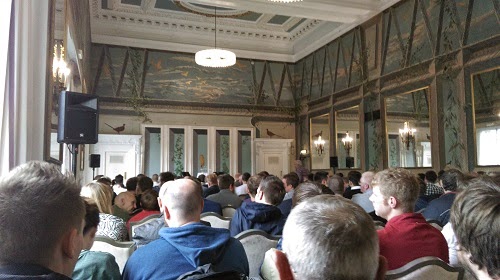
Guillem Balague and Graham Hunter

Caledonian Hotel, Edinburgh

On Thursday night, the Scottish capital played host to two giants of the Spanish football media. Calling upon their wealth of knowledge, experience and connections, Messrs Balague and Hunter compered a lively, entertaining evening of anecdotes and debate. Treating Messi’s emergence as the catalyst in a major turning point in Spanish football, they traced the fascinating Barcelona journey from Cruyff to Luis Enrique, taking in Laporta, La Masia, Ronaldinho and Guardiola along the way. The second half of the show saw them field an array of questions from the audience. Suarez, Fabregas, Neymar, De La Peña, Van Gaal, Almeria: you name it, they discussed it.

Afterwards, I caught up with the inimitable Graham Hunter, author of Barca and Spain.

Q. Thanks for your time, Graham. What a great event! You looked like you were having fun up there – how do you find talking about a book compared to writing it?

When you talk about something you’ve done, it does feel a bit embarrassing. You certainly do it to the best of your ability but I certainly don’t do it to garner appreciation. You do it intensely to try to communicate something. Since the first minute I’ve written about football, that’s what I’ve done. I remember it was an enormous surprise when anybody thought anything of what I wrote – you never lose that sense of something being worthwhile.

It’s not through any sense of false modesty that I say that I found the books really hard to do. I was trained as a newspaper man and it’s only subsequently that I’ve gone on radio and television. When you’re a newspaper man, you’ve got blank pages every day and part of the adrenaline is planning how to fill them, not just filling them with shite but working out what’s important, what’s a feature, what’s an interview, what’s a news story. Books take a fucking hell of a long time to come to fruition. I was saying to Guillem at lunch that he either assimilates facts more quickly or writes more quickly than me. I find it difficult.

When I talk on stage, it would be an outright lie to say it’s not a pleasure to talk to people about football all night, but you’re nervous. You watch a sea of faces and you’re worried, have they heard it before, am I being boring, do they feel like I’m repeating what they’ve already read? You worry about that. But when you connect with people because they ask you questions, then that’s untrammelled joy. Above all, what I come away with is the sheer joy of connecting with other people who feel the same about Spanish football as I do.

Q. The BackPage Press guys were saying that when they first approached you to do the Barca book you said no.

A thousand times! They spoke to me on the phone having read an article in The Sunday Herald about Xavi. They explained to me over and over again their passion about why they needed a book written about this subject. I said to them, ‘Everybody knows these stories, I’ve got nothing that people don’t know!’ The two things that convinced me were their persistence but above anything else, they told me ‘We’ve got this dream, we’ve started this company, against the odds, we’ve taken out a loan, we’re working part-time because we’re working as sub-writers for newspapers to finance the company. You’re the second book that we’ve asked anyone to do.’ Bascially, they suckered me into it! I didn’t believe I had anything new to say but now it’s been published in 13 or 14 countries, I was wrong and they were right. That’s the only time in my life I’ll say that about them!

Q. Where Guillem has focused on individual figures, you’ve focused on the team element. Do you feel each requires a different approach?

There’s no way to compare. I think he [Balague] is a lot shrewder than me. If you pick Pep and Messi, that’s extraordinarily astute. Both them and their entourages fully participated with him; he picked well. He’s also been more proactive in what he’s chosen. With BackPage Press, I’ve been led to my projects. Guillem has been sharper and good luck to him for that.

Q. In terms of that fascinating ‘access all areas’ approach to sports journalism, what advice would you have for someone looking to find their way?

Leave England. Things in Spanish football have become a little more closed than they were when I moved over, but England has a very closed football society. It doesn’t mean that players and managers don’t talk to journalists, because they do when they want them to write their books! In terms of the culture, of explaining their art and their philosophy, England is Neanderthal. It’s all about secrecy; you won’t be allowed in because you’re the enemy. Whereas in the advanced countries, there’s a symbiosis between football directors, managers, players and journalists. It doesn’t always work, it’s not always harmonious, but it does lead to more intelligent and open debate.

Q. If you could write a ‘behind the scenes’ biography on any footballer or football manager, past or present, who would it be?

I think the second Sir Alex Ferguson book is distinctly less well written and distinctly less well interpreted than the one he did with Hugh McIlvanney. So it’s very tempting to say Sir Alex Ferguson, from 1999 to now. But my ultimate choice would be Cruyff because I still believe that he’s the single most influential man in football ever – player, coach, football director, philosopher. Not all his ideas were original, but pound for pound he’s the most important personality.

Q. And finally, is there a next project in the pipeline?

There have been two suggested to me, but it would be naïve of me to share them with you. I would only accept one that was right for me because I’ve found these two tiring on top of my other work. Ollie Holt, Matt Dickinson, Henry Winter are exceptional at what they do, carrying on their work as brilliant frontline journalists and still writing well. I find it hard to do, so I’ll take my time in choosing.

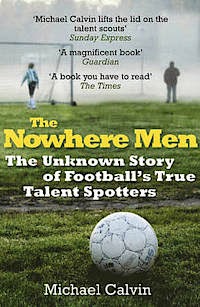
Q&A: Michael Calvin, author of The Nowhere Men

It’s been an amazing few months for sportswriter Michael Calvin. In May, his latest book The Nowhere Men beat the offerings of Messrs Balague and Lowe to win Best Football Book at the British Sports Book Awards. A month later, he completed the double, scooping the Times Sports Book of the Year award. Having reviewed his excellent look at the unknown world of football scouting for the Football Blogging Awards blog, I had a few questions for Mr Calvin, which he was all too happy to answer.

Q. Was the subject of scouting a difficult sell for your publisher? Especially when sports publishing is so focused on media-friendly ‘brands’: a player, a manager, a team or country.

I was very fortunate: everyone involved ‘got it’ from the moment the idea took shape during a chance conversation with Jamie Johnson, Millwall’s chief scout, in the manager’s office after a game at the Den. Ben Dunn, my publisher at Century, instantly understood the potential of exploring such a fascinating, but hidden, world. He related it to the authenticity of my previous book, Family: Life, Death and Football. He’s a football fan (West Ham, unfortunately) and like most fans he was intrigued by the process of discovery. Once I came up with the title, we were off and running.

Q. Was there a Eureka moment behind the Nowhere Men project? Did it emerge from your empathy with the scout’s plight, or were you specifically looking for an undiscovered aspect of the footballing world?

If there was a Eureka moment, it probably happened in my second game out on the road with Mel Johnson, the scout who acted as my mentor. It was an Under 19 international, and his principal target was the Czech goalkeeper. He noticed me doing what I had done thousands of times previously in reporting matches: annotating the team shape and following the flow of play. That wasn’t my job as a scout. I had to concentrate on our man. That intensity of focus made me view the game in a completely different light. It brought out the humanity of the process. That, in turn, stimulated my empathy with both player and observer.

Q. As your book so brilliantly evokes, scouts operate within a closed, ‘tribe’ environment. Was it difficult to infiltrate the fraternity and get them talking, or was Steve Rowley more of an exception?

Scouting is like any other specialist field: it is enclosed and initially hesitant in opening up to outsiders. I was a bit of a curiosity at first, but once they realised I wanted to share their lifestyle and tell their stories, they were intrigued and, I have to say, a little flattered. I quickly became part of the network. I found them brilliant to deal with: even Steve, who was more reserved and uneasy, was politeness personified.

Q. For much of the book, your voice is very subtle, keeping the spotlight focused firmly on your interviewees. Was it difficult to remove yourself from the picture, as a journalist accustomed to offering opinions?

Not particularly, to be honest. Observation has always been my stock in trade as a sportswriter; being a columnist on a national newspaper is the privilege of experience. Sport enshrines the best in human nature, and the worst. That’s what makes it so compelling to write about. The reader sees the scout’s world through my eyes, but I took a conscious decision to allow them to speak for themselves. It is interesting that many readers tell me they loved the ‘Chat Show’ chapter in which I recorded the conversation of Patsy Holland, Allan Gemmell and Barry Lloyd. They gave us a fantastic insight into true football culture.

Q. Which of the many set-ups discussed in The Nowhere Men impressed you most and why? Personally, I felt the team of Matthew Benham and Miguel Rios at Brentford came across particularly well.

Brentford surprised me, because what I discovered defied the perception of the club. I was hugely impressed by the work done at all levels. Interestingly, Miguel and Mark Warburton, who is now manager, come from a City trading background. That makes them more inclined to think laterally and differently. At Academy level, the human chemistry between Shaun O Connor and Ose Aibangee, who are different characters, really works. This is a club operating to a long term strategy: much of that is down to owner Matt Benham, who is a fan, but also utilises his professional experience and perspective.

Q. Do you feel that English football analytics have made much progress in the past year? It’s interesting to read that Brendan Rodgers, widely seen as a very modern manager, still puts such faith in his scouting set-up.

No, I don’t. In much of the Football League there is very little understanding of, and respect for, analysis in terms of performance and recruitment. Far too many clubs are taking the short-sighted, short-term option of employing unpaid interns or recent graduates, who are ready to work for free. They are exploiting the ambition of a new generation of support staff, which is utterly wrong. Liverpool have a strong analytic base, but also have faith in old school scouts like Mel. The wider issue, though, is that too many clubs are becoming over-reliant on video scouting; you cannot beat eyes, ears and instinct.

Q. And finally, having had this privileged education, would you ever consider scouting on the side?!

Funnily enough, I have been asked to look out for players. A few of the scouts keep in touch and ask where I will be at the weekend. They might ask for a favour – ‘see what you think about so and so, will you?’ – and they happily swap news and gossip. It works both ways!

Buy The Nowhere Men here