Maybe you don’t know about me, unless you read Feed the Goat: The Shaun Goater Story, but that ain’t no matter. That book was made by Mr David Clayton, and he told the truth, mainly, but there’s much more to tell. I was quick and I could run with the ball and I did well at Coventry City with Dion Dublin. When Leeds United paid £6million for me, I was rich.
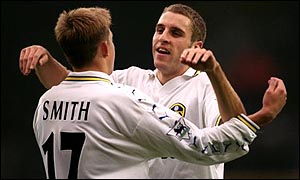
But when you got into the squad you couldn’t go right to playing. First you had to wait for the manager to shake his head at Mark Viduka’s weight, Michael Bridges’ injuries and Alan Smith’s temper. It was deadly dull and I got fidgety. As I sat on the bench, Mr O’Leary would say, ‘Don’t hunch up like that Huckerby’. O’Leary kept pecking at me for not scoring enough goals and it got tiresome. All I wanted was to go somewheres and I warn’t particular about where.
When I couldn’t stand it no longer, I lit out for Manchester City. Alf-Inge Haaland, he hunted me up and said he was going to start a band of winners, and I might join if I could follow the rules. We had to swear an oath and write our names in blood. It swore everyone to play for the team, and never dribble blindly towards the corner flag; and if anyone was in space, whoever had the ball must pass it to them. Everybody said it was a real beautiful oath, but it had me worried. Then Stuart Pearce says:
‘Here’s Huckerby, he don’t know the offside rule – what you going to do ‘bout him?’
‘Well, hain’t he a striker?’ says Alf-Inge.
‘Yes, he’s a striker, but you can’t never find him onside,’ says Psycho.
They talked it over, and they was going to drop me, because every player must know the offside rule, particularly a striker. Nobody could think of anything to do and I was most ready to cry. So I offered to learn the offside rule and stay onside from time to time.
Everybody said: ‘That’ll do. Huck can come in.’
I made my mark on the paper and collected my things. I went tip-toeing along to the Leeds Central railway station, and sure enough there was Shaun Goater waiting for me.
Now the way that Mr Clayton’s book winds up is this: I fed The Goat and he scored, and so did I, and Man City were champions of the First Division. Old Mr Keegan said I was coming along slow but sure, and doing very satisfactory. I was pretty-well-satisfied with myself too.
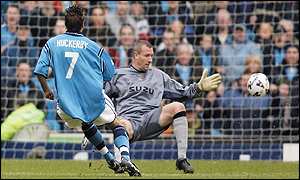
But then in the Premier League the old thing commenced again. We had Nicolas Anelka, Robbie Fowler and Jon Macken and I was back on the bench. It was kind of lazy and jolly for a bit, laying off comfortable all day, and no football to play. But how slow the time did drag along after a month. When I came on I couldn’t score a damn thing and I was offside most of the time. We had a mean young midfielder called Joey Barton and he liked to give me a good going-over.
‘Shucks, it ain’t no use to talk to you, Huckerby. You don’t seem to know anything – you’re a perfect sap-head.’
I was six years older and I had an England B cap but that didn’t mean a thing to him. Joey warn’t never in a good humor; that was just his natural self, especially when the liquor took him. I warn’t scared of him worth bothering about but he was always cussing me.
‘You know one season you was caught offside 98 times. You think you’re better’n the First Division, don’t you? I’ll take it out of you.’
I was dog-tired of everyone pecking at the same old problems – my hunchback run, the way I couldn’t never stay on my feet. No-one tried to understand what it was like to be in my shoes. It was dreadful lonesome warming the bench with Kevin Horlock and Carlo Nash.
Mr Keegan sent me on loan to Nottingham Forest and I did ok back in my home town. I felt kind of sore about everything at Man City but I knew it was time to move on for good. Mr Worthington at Norwich City wanted me and that was good enough for me. I just needed to find a way to leave before Joey knew I was gone.
One night, I took my two First Division winners medal and my England B cap and I put them in a suitcase; then I done the same with my signed Shaun Goater shirt, one of Jason Wilcox’s judo black belts and a prototype ‘Dube’ that Dion gave me. It was about dark, now; so I walked down to Manchester Piccadilly, and waited for the first train to Norwich to come.
I was pretty tired when I got to my seat. The first thing I knowed, I was asleep. When the ticket collector woke me up I didn’t know where I was. I set up and looked around, a little scared. Then I remembered. I was free from Joey and free from the Premier League with all its mean linesmen and decent defenders. I knowed I was all right now. I felt powerful lazy and comfortable, like when Mr Keegan left me on the bench for a few games.
When I got to Carrow Road I warn’t feeling very brash. I’d never been to Norfolk and didn’t know nobody there. I catched a glimpse of a man going into the changing room. I went for it, cautious and slow. It was Marc Edworthy!
‘Hello, Marc!’ I says and skipped out.
He ran up and stared at me wild. I was ever so glad to see my old Coventry teammate. I warn’t lonesome now.
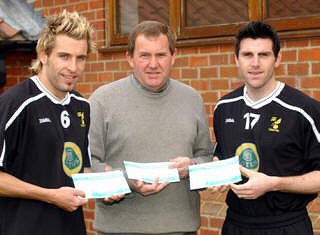
It was a mighty nice squad, and a mighty nice stadium, too. I practiced hard every day to get the hang of things, and by-and-by I could do pretty well up front with Paul McVeigh, Leon McKenzie, Matthias Svensson and Iwan Roberts. Mr Worthington said I must quit running offside all the time. I took notice, and done better. We won four games in a row and I even scored a goal. I wanted to win the First Division again but Marc didn’t believe we could go that far. I said come on, we’re better than the Tractor Boys, and West Ham and West Brom. So on we prowled.
‘I wish Dion was here,’ I says to Marc in January. ‘He’d call this an adventure and he’d score goals all day long. And wouldn’t he throw style on it?’
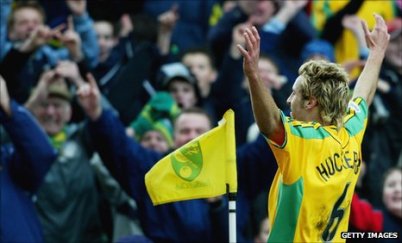
Marc manned the defence and I struck the goals. I judged Mr Keegan would have been proud of me as we went a-booming towards my third First Division title. The Norwich fans loved me and that was a special feeling I must say. They were taken with my style – the big shirts, the beach blonde mullet, the dives in the penalty area.
Marc had an uncommon level head. He judged that 40 points would fetch us to mid-table in the Premier League and then we’d be out of relegation trouble. Well, after 13 games we didn’t have one win to our name. We were in an awful peck of trouble. The league table made me so sick and scared I couldn’t budge from Ceefax. If you think it ain’t dismal and lonesome down at the bottom, you try it once – you’ll see.
I almost just give up, then. I scored more goals but even signing Dean Ashton warn’t gonna save us. Late one night Marc called me and he started talking wild about how we were relegated already.
‘You been a drinking?’ I says. ‘You’re a tangle-headed old fool, Marc. You did dream it, because there didn’t any of it happen.’
‘We’re still in the Premier League?’
‘Of course we are!’
If we worked hard enough, I told him, we would get out of the zone and be free. We beat Manchester United, Newcastle, Charlton and Birmingham but it warn’t no use in the end. We went down but the Norwich fans said I warn’t to blame. They said I could have a home there as long as I wanted it. I won the Norwich player of the season award and they voted me into their Hall of Fame, too. That was a beautiful night.
Marc was awful disappointed. I said never mind, we’d be back, I reckoned. But Marc went to Mr Worthington’s office and bullyragged him about the relegation. The numskull said things he never should have said, and so he had to quit for Derby County. I was real sorry to see him go.
‘Head up, Huckerby!’ Mr Worthington shouts at me in training.
I didn’t understand. I warn’t so miserable; the First Division was my home, after all.
‘Huckerby, git your head up when you run! That way you might pass to a teammate one time.’
They was tough times for all of us. Then in the middle of the season, Robbie Earnshaw arrived from West Brom. Earnie was tiny, gentle and sweet, like a dove, but they said he was a grown man. Together we scored a nice number of goals but Reading and Sheffield United was miles away at the top. Earnie warn’t at all happy with ninth place but I never said nothing about his days in the Third Division. If I never learn nothing else out of Joey, I learnt that the best way to get along with people is to keep peace.
The new season was started when a voice not twenty-five yards from me, says ‘Is that you, Huckerby? I’d know that hunchback anywheres.’
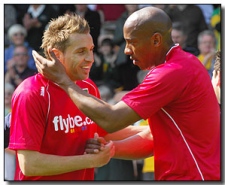
It was Dion’s voice – nothing ever sounded so good before. He grabbed me and hugged me, we was so glad to see one another. One thing was dead sure; me, Earnie and Dion would form a merry gang. Against QPR we all scored but the problem was the fools in our defence. Something was a-brewing, for sure. Then they sacked poor old Mr Worthington. We was in relegation trouble for a bit but we escaped thanks to our goals. I won the player of the season award again, and Dion was second. I done found a home where they loved me even if I couldn’t hit double figures no more.
Earnie headed for Derby County and in October we was bottom of the First Division. It made me shiver and so I kneeled down to pray. I knew I was full of goals, full as I could be, but why did they just trickle out from time to time? Why, it was astonishing, I felt as light as a feather, right straight off, and my troubles all gone. I would go to work and steal Norwich out of the relegation zone again.
We warn’t all right and safe until the last game of the season. That day we got too satisfied and we lost 4-1 to Sheffield Wednesday. Deon Burton scored two we played so bad. I scored our goal and the fans they was so proud and joyful. Norwich was free for another season and I had loved the adventure of it. As me and Dion waved goodbye, I was happy and satisfied, like a jug goggling out butter-milk. If I’d a knowed what a trouble it was to make a book I wouldn’t a tackled it and ain’t agoing to no more. I’ve got to light out for the United States now, because Mr Roeder will have me warming the bench next season and I can’t stand it. I been there before.
THE END. YOURS TRULY, DARREN HUCKERBY FINN
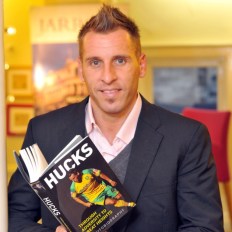
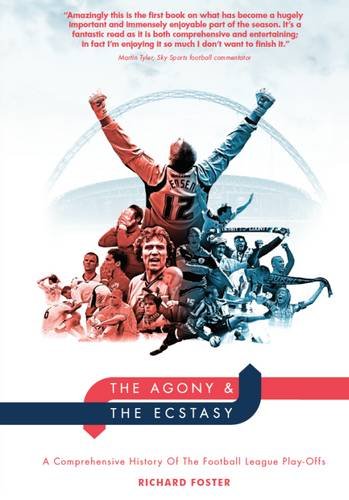 I have a vivid memory of sitting glued to the 1998 First Division play-off final. As an entitled Premier League fan, I knew nothing about either team but I soon declared my allegiance. I chose Charlton – Richard Rufus, Saša Ilić, Clive Mendonca – and cheered with glee as they beat Sunderland on penalties after an incredible 4-4 draw. The play-offs were an alien concept to me but I was sold straight away on the downright drama. It never crossed my mind that they might only be as old as me.




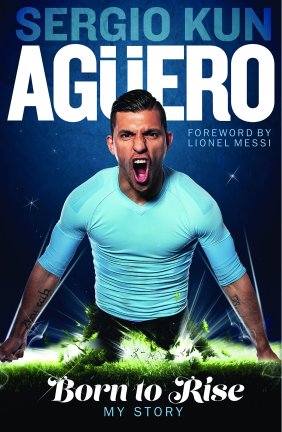 On first glance, Born to Rise: My Story looks like classic Christmas football fan fodder. On the cover, Agüero roars out of a football pitch in a plain light blue shirt (Manchester City obviously refused to give image rights), his Elvish tattoo on display. His name is big and central, next to that of his best friend Lionel Messi, who provides a pretty insipid three-page foreword.



 Of Pitch & Page