Pep Confidential

Pep Confidential: The Inside Story of Pep Guardiola’s First Season at Bayern Munich

By Martí Perarnau

BackPage Press, 2014
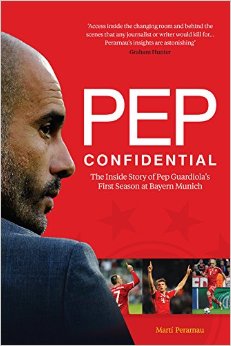
PepHaving read Another Way of Winning, Guillem Balague’s biography of Pep Guardiola, I felt pretty familiar with The Philosopher and his work. But Martí Perarnau’s Pep Confidential is another level of intimacy entirely; where Balague offered a well-focused panorama of Barcelona 2008-12, Perarnau delivers the equivalent of Team Cam. Bayern Munich 2013-14 – one year, one team, one very special manager. This is unrestricted access of the kind Castel di Sangro gave Joe McGinniss, combined with intelligent insight of the kind Philippe Auclair provided for Cantona and Henry. Rarely, if ever, has one season been so intricately and rigorously explained.

The detail is extraordinary, if a little overwhelming. Pages and pages are dedicated to training regimes and tactical minutiae. Rondos, pivotes, the False Nine, zonal marking – like the Bayern players, the reader is quickly immersed in Pep’s football ‘language’. Numbers, too, feature heavily – the law of 32 minutes, 4 second pressing, 40m running, 15-pass moves, the 16 ‘starter’ squad, the defensive line starting 45m from goal. There is even a stat for the average amount of time Pep spends gesticulating during a game (70% in case you wondered). And then there are the formations, many of which Pep and his staff invent in the early hours of the morning like mad scientists: 2-3-2-3, 4-1-2-3, 4-2-1-3, the successful 3-6-1 and the disastrous 4-2-4. In November’s 3-0 win over Borussia Dortmund, Bayern move through four systems in one game.

As well as Pep Master Tactician, Pep Confidential also showcases Pep Master Man-Manager. When his head’s not buried in game plans and video analysis, Guardiola is busy ‘squeezing’ the talent out of his players, whether that be developing his protégé Pierre Højbjerg, massaging the egos of Franck Ribery and Arjen Robben, consoling the injured, or teaching important new roles to Javi Martinez and the pivotal Philipp Lahm (pun intended). As a result of this generosity of spirit, players are quick to buy into his ideas. Dissenters are few and far between, with Mario Mandzukic the only named rebel. Rather than a stubborn visionary, Pep emerges as an open-minded lover of the game, eager to learn from German football and vice versa.

Pep Confidential feels like the kind of dossier Guardiola himself would love to read about each and every team he faces: exhaustive, repetitive, obsessive to the verge of insanity. 120 pages in and the season is just starting in early August; 300 pages in and the season-defining defeat to Real Madrid is mentioned for the first time. Perarnau opens the book with Guardiola’s fascinating conversations with Grandmaster Garry Kasparov, and chess proves a very apt point of reference throughout. ‘Patience and passion. Guardiola’s two main weapons’ – for Pep, perfect football is tac-tac-tac (never to be confused with the dreaded tiki-taka) then pam!, deft midfield dominance leading to incisive, goalscoring chances. The one time he betrays this principle, his team are beaten 4-0 at home by Ronaldo and co. and knocked out of the Champions League. As Karl-Heinz Rummenigge puts it, ‘he deserted the middle of the pitch and opted for much more direct football’. On this occasion, Perarnau loudly condemns Pep’s choice of tactics, but then Guardiola has always been his own harshest critic.

As brilliant a portrait of Guardiola as it paints, Pep Confidential is perhaps most significant in its study of a team’s momentum over a season. Following on from the treble success under Jupp Heynckes, it’s a story of Bayern Munich trying to maintain focus and desire in the face of exhaustion and complacency. Hot on the heels of the joys of March, come the woes of April. As Perarnau concludes, ‘a team is a living entity, not a frozen image. It grows and flows, retreats and advances – a team is the sum of all its successes.’

Buy it here
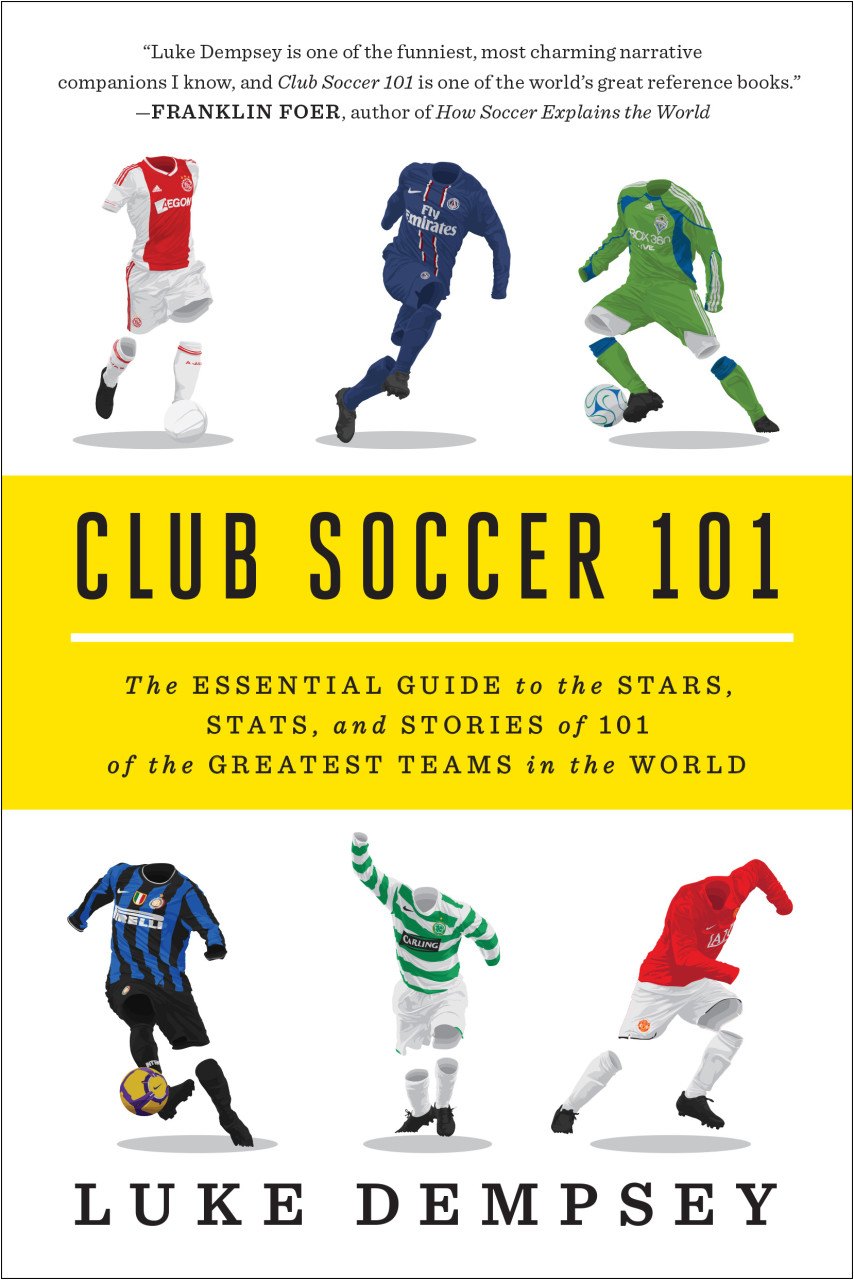
Club Soccer 101

Club Soccer 101: The Essential Guide to the Stars, Stats, and Stories of 101 of the Greatest Teams in the World

By Luke Dempsey

W.W. Norton, 2014

clubsoccermech.indd

When I think of football reference books, I picture a library of fat, blue, abandoned Rothmans Yearbooks collecting thick cloaks of dust. Like the knife-sharpening man, the concept of football facts on paper has surely been put out of business, hasn’t it? After all, websites like Squawka and Opta can provide you with more detailed and more up-to-date information at the mere touch of a button, and for free. Faced with this burgeoning stat market, Soccer 101 is a very pleasant reminder that reference books need not be dry, monumental and costly. Luke Dempsey’s labour of love gives the lowdown on 101 of the world’s greatest club sides in less than 450 pages of a nice, waxy paperback (£9.99). Excluding the acknowledgements, appendices and index, it works out at 4.16 pages per team (no charge for that calculation!).

Of course, this can only be achieved by sacrificing a bit of depth for X-Factor. The selection is strong and the writing is sharp and witty, full of wry asides and great anecdotal particulars. Dempsey pokes gentle fun at the likes of Paolo Di Canio, Felix Magath, ‘Woy’ Hodgson and Alexi Lalas, plus more risqué fun at Copenhagen’s initials (FCK). The surprise inclusion of Norwich City is worth it for the description of ‘one-hit wonder’ Jeremy Goss’ winner against Bayern Munich in the 1993 UEFA Cup: ‘It was a result no one imagined could happen; it was German arrogance in the face of plucky little Brits dressed like birds.’ Other highlights include Eusebio’s sportsmanship, Duckadam’s penalty heroics and Amadei, the 15-year-old baker. To tell you which clubs they played for would only spoil the treasure trove experience.

There is plenty of more serious content too, however. Pinochet’s Colo Colo, Franco’s Real Madrid, Il Duce’s Lazio, World War Two’s ravaging of Central and Eastern Europe; Soccer 101 establishes the important political contexts that define the present day. As brief as the club summaries are, the key details are all there for the budding football historian: ‘the stars, stats and stories’, as the subtitle suggests. Each team’s section begins with a fact file – location, date of origin, nicknames, stadium (with capacity), home colours, leading goal-scorer and most-capped player. Sadly, there are a few blanks for the less-celebrated teams but it’s a tiny hole in the overall fabric.

Soccer 101 is the perfect companion for football nights home and away, familiar and exotic – Arsenal in the Premier League, Bayern Munich in the Champions League, Cruz Azul in the World Club Championship, Dinamo Zagreb in the Europa League. Dempsey’s guide is a must for fans world over, a reference book that’s guaranteed to be well-thumbed.

Buy it here

Promised Land: A Northern Love Story

Promised Land: A Northern Love Story

By Anthony Clavane

Yellow Jersey Press, 2010

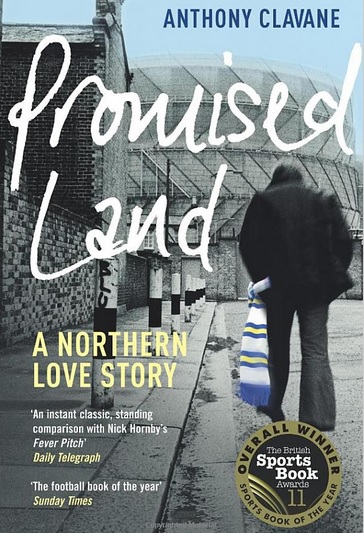
Promised LandFor all the acclaim and attention, there remained a sad and predictable note to the reception for this ‘Northern Love Story’ four years ago. The Daily Telegraph compared it to Fever Pitch, The Sunday Times called it ‘the football book of the year’ and there was even praise from The Damned United author David Peace. Unfortunately, what these excellent associations did was pigeonhole a book that was always about a whole lot more than sport. Promised Land is a set of interlocking, coming of age tales: the story of a city, Leeds, alongside the story of the book’s Jewish author. The story of a football club – Leeds United – forms the third side of the triangle, the binding baseline of the equilateral. Incorporating politics, culture, literature and religion, Promised Land is the best expression of the game’s communal significance that you’re ever likely to read.

While Clavane’s engaging personal narrative is woven throughout, it’s never as self-centred as Hornby’s. A crucial balance is upheld between the subjective and the objective, between the love letter and the social investigation. Rather than the central theme, Clavane’s journey through adolescence is rarely more than a narrative tool to transport the reader from a to b to c to d to e. Because in little more than 250 pages, Promised Land takes in more than 50 years of British social history. In fact, if we include the early section on his ancestors’ arrival in England, that figure becomes 110. Such scope requires the tightest of structures and the most focused of analyses. The governing principle of Promised Land is this; ‘United’s peaks and troughs over the past fifty years have coincided with the peaks and troughs not only of the game itself, but also of the city of Leeds and its Jewish community.’ Simple, shrewd, succinct.

Promised Land is arranged around four key time periods: Don Revie’s side of the 1960s and the meteoric rise of the Northern Man; the decline and degeneration of post-1975 Britain, dominated by ‘the three Rs – the recession, the Ripper and the racism’; the early 90s revival of both club and city; and finally O’Leary and Risdale’s ill-fated attempt at Premier League domination, just as the city too ‘squandered its boom money on insipid, gimmicky projects’. In amongst this chronological progression, Clavane’s study sweeps deftly across the years: ‘Cantona, like Johanneson and Clough…epitomised the flamboyance and sense of adventure Leeds had always failed to accommodate’, ‘It had gone the way of all other Leeds dreams, from Brodrick’s – through Revie’s – to Risdale’s.’

The result is a convincing, overarching argument for Leeds’ ‘nearly-man inheritance’. 1975, 1992, 2001, 2011 – ‘at the most crucial moments in their history, just as they were about to close in on their pinnacle, they have, quite simply, blown it’. Beautifully crafted and meticulously researched, this final reckoning rings loud and true. Clavane is in his element, combining the authority and precision of the historian, with the passion and obsession of the football writer. Promised Land is at its absolute peak when placing the two eras of Revie’s reign (‘Dirty Leeds’, then ‘Super Leeds’) within the context of the post-war regeneration of the north.

The book concludes with a backwards timeline inspired by the ‘seven sabbaths of years’ prophesised in Leviticus. It’s the football writing equivalent of Ulysses and forms a fitting finale to what is a hugely ambitious and innovative study of everything Leeds; football and everything before, during and after.

Buy it here

The Blizzard + Eight by Eight + Rabona

The Blizzard (Issue 12), Eight by Eight (Issue 2) and Rabona (Issue 2)

In decades past, football magazines were a small, select bunch; Shoot and Match for the kids, World Soccer for the international fans, FourFourTwo for the Premier League fans and WSC for the real fans. In the last few years, however, the market has been flooded with more and more creative and scholarly options. Mundial Mag, The Football Pink, Pickles Magazine, The Howler, The Blizzard, Eight by Eight, Rabona – welcome to the football ‘hipster’ movement, I hope you brought your wallet.

The Blizzard (£12 for latest edition, pay-what-you-want for back catalogue), the brainchild of Inverting The Pyramid author Jonathan Wilson in 2011, looks and reads like football’s answer to The Paris Review. The Contents pages read like a Who’s Who of the sport’s best writers: Sid Lowe, James Horncastle, Graham Hunter, Philippe Auclair, David Winner, Simon Kuper and Tim Vickery, to name but seven. At nearly 200 pages a time and with articles about chess, pianists and political polling, The Blizzard is not for the fair-weather football fan, but its quality is undeniable. Issue 12 opens with the Barcelona-Real Madrid rivalry. We get the Lowe-down on Carles Rexach and Jorge Valdano, a Miguel Delaney interview with the David Bowie of football, Johan Cruyff, and best of all a wonderful extract from Hunter’s Spain on the career of Vicente Del Bosque. As trilogies go, you don’t get much better than that.

The range and scope of the publication are perhaps its most impressive features. Highlights include James Montague, ‘The Indiana Jones of soccer writing’, on the fascinating story of Guma Aguiar, the ‘Messiah’ of Beitar Jerusalem, and Richard Jolly’s persuasive comparison of the careers of Ryan Giggs and New York Yankees’ short-stop Derek Jeter. There’s even a brilliantly bizarre piece of fiction from Iain Macintosh. This instalment of the story of Bobby Manager features guest appearances from Brian Clough, Peter Taylor, Karren Brady and Carlton Cole. If there’s one criticism to be made of The Blizzard it’s that, for a magazine about the beautiful game, it’s all a bit staid and text-heavy. Bartosz Nowicki’s striking photos of Cardiff City’s Premier League promotion are a welcome relief, but more would be nice.

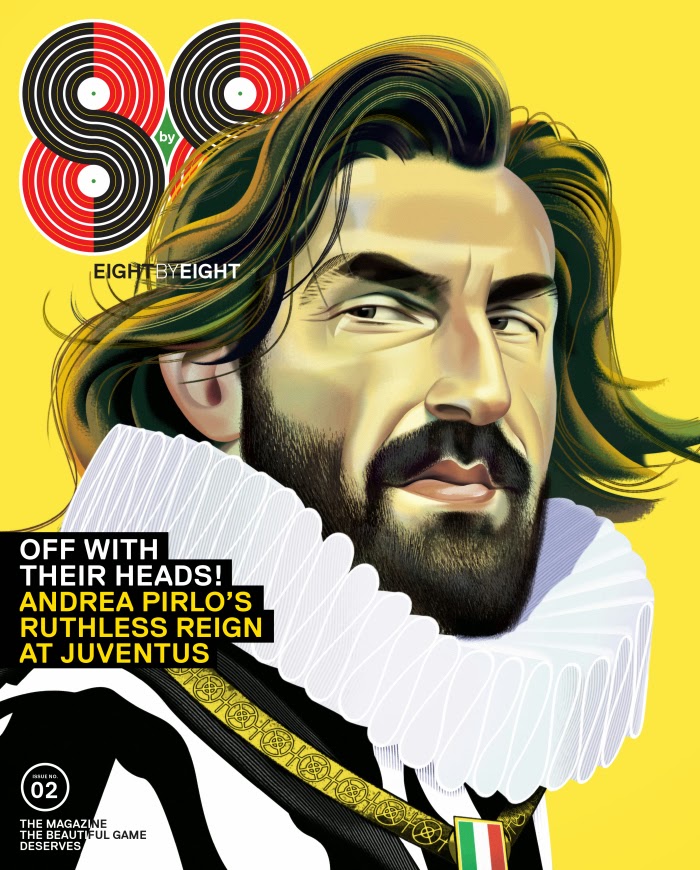
The same could never be said of Eight by Eight ($15.99, or £12 at Foyles), a trendy new quarterly publication from New York City that brilliantly showcases the rapid rise in football artwork. In Issue 2, there are 23 contributing artists, one more than there are contributing writers. The cover image of Andrea Pirlo as a 17th century royal is only the start of the visual delights. Particularly impressive are Dylan Fahy’s stunning 7-page timeline of the history of Juventus and Ben Kirchner’s illustration of their midfield quartet of Paul Pogba, Arturo Vidal, Andrea Pirlo and Claudio Marchisio. Eight by Eight is an absolute joy to behold.

The written content, too, is of a very high quality, aided by the fact that Eight by Eight and The Blizzard share the prestigious talents of Jonathan Wilson, Miguel Delaney, Philippe Auclair and Paolo Bandini. In line with the high-design, magazine feel, the articles here have more of a commercial appeal, twinning big name subjects with solid insight. Some cover less than one page, none exceed three. Wilson reports on Wayne Rooney, Delaney on Roy Keane, Bandini on the Juventus midfield. Best of the portraits, however, is Ken Early’s excellent analysis of Steven Gerrard’s footballing strengths. More weighty themes are covered in Auclair’s moving and angry look at France’s problems with race and religion in light of Nicolas Anelka’s quenelle gesture.

On the whole, words and images are balanced nicely but at times the illustrations do disrupt the flow, forcing pieces to conclude on later pages. Overall, there is perhaps just a little too much going on visually, but these are early days for the publication.

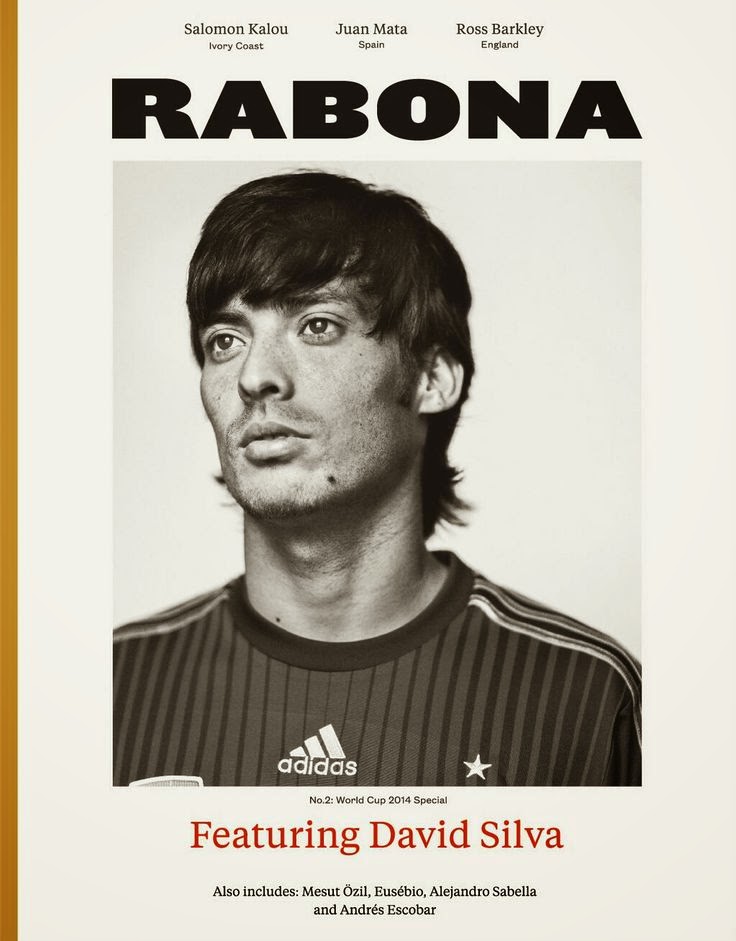
London-based magazine Rabona (£5.75) have taken a very different, minimalist approach to all matters ‘football trendy’. With over 125 sparsely-filled pages, image and text certainly have plenty of room to co-exist harmoniously. Issue 2, the World Cup 2014 Special, even opens with an elegant study of World Cup matchballs and kit badges – this really is a hipster’s paradise.

Rabona sits pretty beautifully between the poles of The Blizzard and Eight by Eight. While the player interviews (Mata, Kalou, Barkley and Silva) aren’t exactly mind-blowing, the journalistic pieces are excellent. James Montague writes on Swiss immigration and identity, James Young tackles Brazil’s social situation, Seth Libby looks at Bob Bradley’s fascinating time in Egypt, and Carl Worswick considers Colombian footballer Andrés Escobar’s murder 20 years on. All of this very political content is teamed up with crisp design, striking photography, a glossy mid-section and some great player sketches from Kate Copeland. Better proofreading aside, it’s difficult to think of ways to improve the reading experience.

It seems harsh to be picking holes in such fantastic magazines. Between them, The Blizzard, Eight by Eight and Rabona represent the full spectrum of a really exciting development in football writing. How nice it is to be spoilt for choice.

Shocking Brazil: Six Games That Shook The World Cup

Shocking Brazil: Six Games That Shook The World Cup

By Fernando Duarte

Arena Sport Books, 2014

Modern non-fiction is often as much about reinventing the wheel as it is about offering the reader new information. As simplistic as it is to say, facts are facts and once they’re known, they’re known. So new authors shuffle the existing pack before (fingers crossed) revealing a hidden ace or two: a modern perspective perhaps, a more accessible tone, and hopefully some unique insight and testimony. In Shocking Brazil, regular Guardian contributor Fernando Duarte lays down all three as he traces the history of Brazilian football through six of its biggest World Cup disappointments: 1950, 1966, 1974, 1982, 1998 and 2010.

Focusing on the losses may seem a fairly negative angle to take, especially for a Brazilian native. However, Shocking Brazil doesn’t feel pessimistic; instead the approach is realistic with patches of optimism. Rather than ignoring the Seleção’s well-known history of success – 1958, 1962, 1970, 1994 and 2002 – the narrative celebrates this by detailing the setbacks that led to these triumphs. The result is a necessary and successful reconfiguration of Brazilian footballing history; as Duarte puts it, ‘The losing stories are a significant source of untapped information on the development of the game.’ Would Pele and co. have gone on to win back-to-back titles if it weren’t for the Maracanazo in 1950? Would Ronaldo have played as well in 2002 if he’d won it in 1998?

With its ‘tales of mismanagement, corruption and chaos’, Shocking Brazil highlights the recurring obstacles and distractions that the Seleção have faced over the years. The fascinating ‘political intrusions’ that hindered the 1950 and 1974 sides may have subsided somewhat in recent years, but they’ve been replaced by equally demanding sponsors and contracts. As expected, Duarte is at his most enlightening when dealing with these more recent, and less-discussed, events, including conspiracies linking Nike to Ronaldo’s 1998 breakdown, and Dunga’s battle with the Globo media empire in 2010. Written with the informal charm and wry humour of a die-hard fan, these sections feel as vibrant and fresh as Neymar Jr himself.

What the book so brilliantly conveys is the multiple layers of politics at play in Brazil, and the massive disruptions they can cause. Historically, the national football sphere, like the government sphere, has been dominated by dictator figures looking to exploit, as much as maintain, the success of the team. Between the shoddy preparation for 1966 and the shambles made of the 1998 Ronaldo health-scare, Duarte has only bad things to say about the CBD; ‘Brazilian management has been historically flawed in its organisation and structure.’ One of the best features of Shocking Brazil is its discussion of the domestic game alongside the national game. Two of Duarte’s most prominent themes run parallel with good reason: the mass exodus of talent to Europe, and the Seleção’s abandonment of ‘The Beautiful Game’ following the 1982 post-mortem. With the notable exception of Neymar, the Campeonato Brasileiro has been severely weakened since the ‘Dunga Era’. As Gilberto Silva, one of the numerous high-profile contributors, concludes,’It is unacceptable that in the 21st century we still have clubs run so poorly.’

And on top of the weight of all this incompetence, dishonesty and greed, is the expectation of a population of 200 million people. ‘A third consecutive failure in the World Cup could have serious consequences for Brazil’, Duarte predicts ominously. In many respects, Shocking Brazil reads like a very handy ‘what to expect’ guide for World Cup 2014, where the Seleção have the additional pressure of home soil for the first time since the disaster of 1950. High-profile omissions, patchy form, a lone superstar; all familiar factors. After Thursday’s unconvincing 3-1 victory over Croatia in the opening match, Hugh McIlvanney wrote, ‘Improvement can be expected but greatness seems out of reach’. A goalless draw against Mexico suggested even progress might prove slow. As in 1998, 2006 and 2010, Scolari’s team seems unlikely to set the world alight. And as in 1966 and 1974, Brazil are up against European sides like Spain and Germany that will know their style and show no fear. So will World Cup 2014 prove to be a sixth triumph or a seventh disaster?

Buy it here